Black Metal, Death Metal, Grindcore, Thrash and Heavy Metal Reviews from the net's original Heavy Metal site

Metal Genres

Death Metal Black Metal Grindcore Thrash Speed Metal Heavy Metal

Metal Music

Heavy Metal F.A.Q. Interviews Philosophy Metal Concerts Heavy Metal CDs Heavy Metal MP3s

Metal Media

Articles Heavy Metal Zines Heavy Metal Video Heavy Metal Books Metal Links

Metal Community

About Contact Metal Forum Letters Mailing List

Interview: Quorthon

Black metal and death metal legend Quorthon of Bathory took some time to answer our questions while he was busy recording the Nordland series of albums. Among all the interviews we've done, this may be the most focused and articulate, with one of the most passionately intelligent figures black metal has ever produced.
1. the dominant influences on the earlier bathory work appear to be venom and slayer. were you listening to other music at the time, including hardcore punk like discharge?
I think it is very easy for people to be making that kind of connotation, simply because those two acts in particular are perhaps among the first ones that comes to mind when the roots of extreme metal is being discussed. But actually, I have never owned a Venom or Slayer album. And I don't give a fuck if people believe that or not.

I know some people believe the change of style for BATHORY, in terms of the music and lyrics around 1988-1990, happened because we must have got turned on from Manowar. That's another total misconception. I have never owned a Manowar record. And I don't give a fuck if people believe that either. Not that it matters though.

I have of course heard Slayer (an act, which by the way does have all my respect for being original and for sticking to their roots in much of what they do). And I have heard a handful of tracks by Venom.
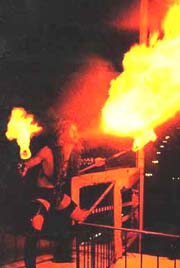
quorthon of bathory breathing fire in one of the most iconic images of black metalIn 1986-1988, BATHORY had a drummer who was heavily influenced by Manowar. He didn't enjoy any other type of metal, but he was somehow sold on Manowar. It wasn't like we decided to copy what they were doing. However, the typical heavy Manowar beat seemed to perfectly suit my new ideas for lyrics at the time. The way it came about was this; in an effort to get away from the whole "are they true satanists or not"-discussions that went on in the media at the time (sort of drawing the attention away from what was truly important, the music), I felt I wanted to replace the whole demonic & satanic bag with something that was pure from christian and satanic bullshit.

The pre-christian Scandinavian Viking and vendel era seemed perfect for lyrics and arrangements. Had BATHORY been a japanese act, we might as well have picked up the Samurai culture. Had we been an Italian act, it could easily have been the Roman empire era. Now, we happened to be a Swedish act and the Viking and Vendel era seemed exciting in terms of writing music and lyrics. The heavy Manowar beat that this one-time BATHORY drummer came up with one day in the rehearsal place, is a Manowar contribution. But I wonder if that's enough to be called a source of inspiration or influence.

My personal reason for forming BATHORY was I wanted to create a mix of the atmosphere of early Black Sabbath, the energy of early Motörhead and the pace of early GBH. We were just three shit kids coming out of school at the time, with absolutely no knowledge at all about any other acts. Remember, Metallica released their first album around the time we entered the studio for the first time. Slayer too released their first album at the same time. We were totally in the dark about any underground movement in Europe. It wasn't until way after we had already released our first album that we learned about tons of others acts in Europe and elsewhere playing basically the same type of primitive and dark extreme metal that we were making.

Around the time I formed BATHORY, I was listening a lot to an album by early GBH I believe was called "City baby in attack of the rats". We based half of BATHORY's initial sound and style on that GBH album. I may have listened to some Discharge, but I don't remember any of their songs or any of their titles anymore. The "Ace of Spades" and "Iron Fist" Motörhead albums also meant very much when we formed BATHORY. So did the first handful of Black Sabbath albums.

bathory has always stood above other bands by having a melody connected firmly to a rhythm in the anthemic style of most great metal bands. how did you learn to play guitar, and what methods do you have for conceptualizing the songwriting process?
I don't think I worry too much about whether to include a melody line or not in a song. That will come along in a natural fashion. I have always said that a song and a lyric writes itself. I really don't think too much about the actual writing, the arrangements or even the playing. It's second nature by now.

I don't know if having a melody line in a song would place BATHORY "above" other bands, but sure it does add something special to a song. Extreme noise and brutalities are always fun to do. But if you're trying to tell the audience a story, which we do a lot in BATHORY, I think a melody line will add atmosphere and personality to the story.

I don't see myself as a guitar player. I just use the guitar for writing songs. I may use the bass or a piano when writing other times.

I always write the music first. The lyrics will be added at a very late stage. The mood of the music will determine what the lyrics are to be about. Very seldom will I change anything in a song just because the lyrics might have turned a certain way. In the end it all works out somehow. It puzzles me as much as anybody else.

on "blood, fire, death" an epic sound is present through the use of longer songs with greater symbolic significance to their movements and motifs. what inspired this change from the dark, heavy and primitively simple music of "under the sign of the black mark"?
Probably from reading biographies on masters like Wagner and Beethoven and their works. I began to listen to classical music shortly after forming BATHORY, and from 1985-1986 it was all I would listen to. I had been playing various types of rock in various constellations since 1975, so picking up Wagner, Beethoven, Haydn and others really broadened my musical awareness extensively. The motif signature naturally comes from the world of opera.

Around 1986, I realised we were actually just writing albums full of religious hocus-pocus, satanic rubbish and demonic crap. I was not a Satanist and knew absolutely nothing about occultism or demonic affairs, so I asked myself why should I really be writing about that shit. I mean, we actually got to make albums, so why not try something different. That's when the idea to bring the whole pre-christian Swedish Viking era into BATHORY came about. Not that I knew any more about that period in time, but it was at least a fresh source to draw stories from.

When people ask me today, if I am ever ashamed of the early albums and the lyrics they contained, my answer is "no". We're not ashamed of anything, we all go through stages in life when one thing may be cool for a period of time, and then something else comes along that inspires you in a different way.

Originally, we picked the whole demonic bag up because we didn't feel we could write the same sort of lyrics that the big boys would write. We didn't know shit about riding down the highway on a Harley, drinking whisky out of the bottle while fondling all these loose women. We knew nothing about that life, so we picked up influences from the horror comics we had been reading while growing up, magazines like Vampirella and Shock, as well as all the horror movies we had watched as kids. It was all very innocent. I wouldn't have known the devil even if he jumped up to bite my ass.

"Thus if being-toward-death is not meant as an "actualization" of death, neither can it mean to dwell near the end in its possibility. This kind of behavior would amount to "thinking about death," thinking about this possibility, how and when it might be actualized. Brooding over death does not completely take away from it its character of possibility. It is always brooded over as something coming, but we weaken it by calculating how to have it at our disposal. As something possible, death is supposed to show as little as possible of its possibility. On the contrary, if being-toward-death has to disclose understandingly the possibility which we have characterized as such, then in such being-toward-death, this possibility must not be weakened, it must be understood as possibility, cultivated as possibility, and endured as possibility in our relation to it." -- M. Heidegger, "Being and Time"
do you think later bathory was aiming more toward being a progressive or epic heavy metal band, where early bathory had a good deal more punk/venom-style metal influence on it?
We didn't have any ambitions at all to be any of that. About being progressive or epic, we weren't thinking in those terms. It was just a natural evolution, it wasn't planned or calculated. It just happened. It is so very easy for people in the year 2002 to sit back and name certain periods and labelling people and bands. When you have history and all facts at hand, people tend to file and classify past in a way we never did 20 or 15 years back in time. My recommendation to anybody who has problems getting a good view of all the styles and sounds out there is "- Don't bother - just enjoy. It's just fucking metal."
how have your tastes changed across the years of making music?
Probably in much the same way we all change as people. We develop as we widen our perspectives. This is true for music as well. I'll listen to everything from Glenn Miller to The Beatles, from Wagner to Sex Pistols, from Nick Drake to Beethoven. I hardly ever listen to metal. The only metal I will listen to, is vinyl that I bought 20 or 30 years ago like Mountain, early Kiss, early Saxon, early Motörhead or early Black Sabbath. I haven't bought a metal CD in ten years. The last metal CD must have been Motörhead's "Overkill". The last CD I bought of any kind was last summer, George Harrison's "All things must pass (1971).
bathory at the time of 'blood, fire, death' in full regalia do you think that ideology changes the worldview of an artist, and that this is reflected in their music?
I have personally never allowed for any personal ideologies to influence my music or lyrics. For some years German metal media would say BATHORY was glorifying war and the holocaust in the lyrics. This is not true. We were writing about war and the holocaust in the very same way we were writing about all the other things we have written about; incest, the nuclear arms race, the world wars, the environmental issue, female BATHORY fans, serial killers, religion and fuck knows what else. In other words, as facts, not glorifying. I am not religious and have no political ideals, so for myself personally, writing lyrics is just painting with words and creating a scene.
black metal today has gone through a shaping process of which bathory was part. what do you think are bathory's contributions to the methodology of metal making?
I have absolutely no idea about what's going on out there. I am not going to shows, I do not read the metal media and I do not buy or listen to any modern metal albums of any kind. If you'd play me ten tracks by ten different top extreme metal acts I couldn't tell you what you're playing. I wouldn't be able to tell you where even one out of a hundred extreme metal bands comes from. People seem to believe that I have great knowledge and full view of the scene. I tell you, I know nothing. Nothing. Period.

The funny thing is, a lot of people insist that BATHORY's so called Viking period had a greater impact on today's Black Metal scene, than pure Black Metal of the early 80's. The good thing about evolution is that what's called Black Metal today, may not remind too much of what Black Metal was 20 years ago. Black Metal, Death Metal and all types of extreme metal, will develop further. The ones who get the most out of a diverse scene and constant evolution, is the audience.

As far as BATHORY's contribution is concerned, back in 1986-1991 we used acoustic guitars, harmony backing vocals, intros and outros as well as sound effects to create that specific BATHORY atmosphere. Many bands have been copying that so thoroughly in the past 10-15 years, I believe this special atmosphere itself could perhaps be our greatest contribution.

from what i heard of your solo work (band named "quorthon") it seemed you were moving into a genre where you could use the broad style of rock music to fit in a number of melodic but hookish pop songs. is this a return to your influences, or a changing of taste?
It's funny that some people actually believe that the solo records is what I really want to do and that I only kept on working with BATHORY because it would sell like crazy. This is not true. I have written everything from extreme brutal metal to string quartets, and neither of the solo albums I did gives a more true image of what my inner music is like than anything else I have written.

Everything on the first solo album was accidental. I had absolutely no ambitions or plans. What happened was, I said I wanted to take a year off from music. Then the record company told me that I perhaps should think about a solo record, just to keep myself active. Now, that's a very interesting situation. Not too many guys get to make a solo record. Myself, I had no idea what it would sound like. The offer to make a solo album was a challenge too exciting to ignore. So I wrote some pure guitar based crunchy metal rock material and went down a small studio for a week and a half. I brought with me a guitar, a bass and a drum machine with only one intention and that was to make a record that wasn't going to be anything like BATHORY. Not that I didn't like working with BATHORY, I just thought it was a good opportunity to "kill" the very erroneous image of "Quorthon" which had developed in fanzines and within the metal scene in general. People thought I was a neo-nazi satanic Viking who drank blood and ate infants, who lived in a bats cave in the north of Sweden and tons of other stupid things. I figured, if I produced a solo album that was miles from BATHORY, incorporating a little rock, blues and even punk, perhaps the most fanatic nut cases would be scared off.

The second solo album came about because people wrote me and said they were now very interested to see what I would come up with on a second solo record. So I wrote a lot of material, mixing The Beatles, Sex Pistols and Mountain plus punk. I have no plans for a third solo record, but having said that, I might just as well record a third solo album in future if I feel like it.

when you see bands today making black metal in the style of the nordic generation after 1987 (inspired by your "blood, fire, death" and sarcofago's "INRI" in my supposition) what do you see as the possible future directions for that style of music?
Like I said previously, I do not think in terms of "genuine" or "true" metal versus "not-so-genuine" or "untrue" metal. My philosophy is; the more versatile and innovative a scene is, the more the audience will get out of it. It would be a very poor testimony if a scene were to contain only one style of music played exactly the same way, with the very same type of lyrics and image and so on. I think it's more "posing" to be copying a certain style of clothing, wear make-up and use the exact same production as tons of other acts simply because it is the flavour of the day.

As far as the future of extreme metal is concerned, I do not worry at all. I know there will be tons of great bands in the future as well. The scene will be forever. There will be new names, new styles and new topics. The dark, evil and demonic will always be a part of the scene. The mythological themes will be there as well. I agree it would be interesting to see what else will happen as far as topics are concerned.

do you think the world is on the edge of great change? if so what will change, and what is forcing it to change (what needs to change)?
I really don't bother about the world or society at all. I'll be dead in 30-40 years and neither people, politics, religion or society interests me at all.
is the metal underground an effective way of distributing niche music according to its artistic integrity, or a justification for the kind of independent distribution needed to move relatively small numbers of CDs?
There's more than one way to look at the underground distribution; firstly it will allow for acts to target the very type of audience they're targeting specifically. Secondly, people interested in a specific type of music will be able to easily get a hold of very special CD's and vinyl through underground distribution network.

Let's face it, some extreme metal productions will never reach sales figures around 10 000-20 000 copies. A lot of acts will be happy to sell 5 000 or even 3 000 copies. With such a small quantity of CD's sold, few record companies, even pure metal companies will even touch certain bands. The underground will be able to distribute albums made during less expensive circumstances, albums that still will have a lot to offer in terms of interesting arrangements etc. So in that respect, I think that the underground is doing a pretty tremendous job.

But the underground is also exploited by pirates, assholes, haemorrhoids and parasites. There are more illegal BATHORY CD's circulating in the underground than genuine official BATHORY albums released. There's fake "BATHORY live albums" out there, I have heard of "Quorthon rehearsal" cassettes and "lost recordings" on CD, and this absurd list just goes on and on. I will occasionally email these mailorder companies and underground metal shops, and tell them that they are distributing BATHORY fakes and illegal crap. Also, I will tell them that not only are they violating international laws of copyright and publishing rights, they allow the bootlegging pirates and haemorrhoids to use their network for criminal purposes. That's not underground, that's theft and breach of trademark laws etc.

I have heard of some really awful quality bootleg BATHORY CD's and feel sorry for the fans that buy them for 15-25 dollars. All they get is crap quality copies of tracks released on our Jubileum volumes. The fans could easily just get the genuine thing from us directly. I came from the underground and I hurt like hell when I hear how young fans are being exploited this way. Any underground shop or mailorder dealer who will help in distributing bootleg crap is killing the underground.

do you have any spiritual beliefs, or strong ideological concerns?
Nope, not a glimpse of spirit in me at all.
it seems to me that most metal musicians start their lives more antagonistic to society as a whole, and eventually as they age begin to acknowledge the need for a society but a dissatisfaction with its design. do you have any comments here as general observations?
I am sure a lot of people will mature with age and realise down the road the need for a functioning society. But that probably has less to do with social awareness or a philanthropic pathos. It will have a lot more to do with the fact they're beginning to pay taxes and want to see some results for their money paid.
how do you compose a song and, how integral are the lyrics?
I will just strike a guitar riff and continue from there. If it sounds good enough to work on further, I'll write a song in an hour or so. A day, a week or a month later I may listen back to it and just taste a few words and see what comes out of it all. I rarely plan before writing a song what it should be about. All that will come along the process. I'll say it again, I think the music and lyrics writes itself. I'm just a tool used by the demons of music.
is "twilight of the gods" a rock opera in the style of the who, progressive bands from the 70s, etc?
I don't know where that rock opera thing came from. I guess people had no idea what to call that kind of heavy bombastic arrangements 10 years ago. It wasn't Black or Death Metal, so some people felt compelled to come up with some label for it. But to call it a rock opera is laughable. "Twilight" is no mot a theme album in any way, no track two off "Twilight of the Gods" has got anything to do with eachother, they are all individual tracks with totally different stories. "Requeim" is more a theme album than "Twilight", because it contains with the subject of death in all forms may it be suicide, murder, culture death, genocide or death in war or by cult.
how do you unwind/relax, or, what do you do for recreational purposes? (what do you enjoy besides music)
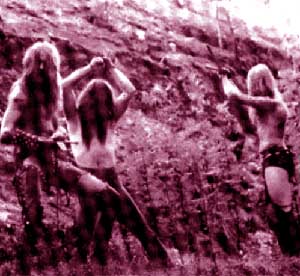
quorthon and bathory outside in purple I'll read a book or stride my Harley-Davidson motorcycles and go for a ride. I used to build a lot of plastic models, paint a lot or collect war memorabilia in the past but not as much these days.
is it possible to return to metal with a different style after one has become one of the founding names of a certain style?
Depends what you mean by "return to metal". I am the same metal underground shit kid today that I was 20 years ago. I'm still playing as brutal a guitar as I have been for 20 years. So it can't be that I've been all of a sudden sliding back into a metal slot for some reason. It's not like I have been travelling the world with a can-can orchestra since last time around.

I can't see what a "return to metal" should point to. If there's no BATHORY album out for a period of 5 years (as was the case between "Blood on Ice" and "Destroyer of Worlds"), some will call that a comeback. That's absurd. Just because you're not in people's face all the time, it's not a come back to have a new album out even if it's more than a year between it and the last release.

People are so stuck with labelling acts and individuals, calling things and circumstances by so many names and whats more just to make life easier for themselves to live, it makes me sick.

the odin mythos present in "blood on ice", "blood, fire, death", and "twilight of the gods" seems to derive inspiration from the nietzschean/jungian view of the human psyche and the culmination of some of its historical inabilities. do you think these ideas are gaining prevalence at this time, or becoming more obscure as society degenerates?
"Blood on Ice" was a saga based loosely on the Siegfried legend and an original story by Robert E Howard. The "Blood Fire Death" album really has nothing to do with Vikings at all except for the title of the track "Oden's ride over Nordland". But that's not really the issue. It's not important if an album or a track is or is not about this or that shit. The important thing is if it gives you the kick inside.

I think people see and hear more things then I really meant to put on them albums. The "Blood Fire Death", "Hammerheart" and "Twilight" albums has been linked together as the "viking-albums", the same way the first three albums "Bathory", The Return" and "Under the Sign" has been tied into a trio. I gave up years ago trying to talk people out of all that crap. It's just atmospheric metal, I don't really bother much about the depth or context etc.

I really don't remember why I picked some stuff up from Nietzche 10 years ago, I wasn't reading much by him. It may have been through Wagner. I think cults, theories and views of all sorts will exist in much the same way for as long as there are people around.

please insert any commentary on the questions, issues addressed, things missed in the interview, or general concluding remarks you may have.
We're just right now finishing a 14-15 track new album to be released in September/October this year. Look forward to it and take care.

Hail the hordes !

Quorthon

"In a sequence of words, i.e. by a chain of symbols, something new and greater is to be represented: rhythm, dynamics and harmony again become necessary on this level of expression. This higher sphere now governs the more limited sphere of the individual word; it becomes necessary to select words, to put them in a new order; poetry begins. The spoken melody of a sentence is not just the sequence of the sounds of the words; for a word has only a quite relative sound, because its character, the content presented by the symbol, varies according to its position. In other words: the individual symbol of the word is constantly being re-defined by the higher unity of the sentence and the character this symbolizes. A chain of concepts is a thought; in other words, this is the higher unity of the accompanying representations. The essence of the thing is inacessible to thought; the fact that it has an effect on us as a motive, as a stimulant of the will, can be explained by the fact that the thought has already become a remembered symbol for a manifestation of the will, for a movement and a phenomenon of the will in one. But when it is spoken, i.e. with the symbolism of sound, its effect is incomparably more powerful and direct. When it is sung, when melody is the intelligible symbol of its will, it reaches the summit of its effect; if this is not the case, it is the sequence of sounds which affects us, and the sequence of words, the thought, remains something distant and indifferent." -- F.W. Nietzsche, The Birth of Tragedy

black mark records, a metal label that has bathory CDs Thanks to Black Mark Records.

Death Metal and Black Metal Search Engine

Black metal fans burning churches in Texas

Sunday 07 February 2010 at 7:09 pm Through the grapevine:


Eight Texas churches barely 150 miles apart have caught fire since New Year's Day...Authorities determined seven of those fires were intentionally set and they are investigating one that broke out Thursday as a possible arson.

Standing in front of the charred rubble of his church, Mahfood said he considers the fires to be a hate crime.

"I don't really think you can look at this devastation and not realize this has hate as its impetus," he said. "We have probably experienced every emotion possible."

United Media Toolbags


The official voices are remaining tight-lipped because they want more evidence before they lunge for a conviction. But if the grapevine is correct, this may turn out to be bigger for metal than most people realize.

Death Metal Day

Friday 05 February 2010 at 8:46 pm

According to the Failbook page for the World Death Metal Day:


its celebrated by listening to lots of death metal and really LOUD and respecting death metal musicians and waas chosen to be on February 14 th because It was meant for those who were disheartened with valentines day and wanted to do something else.


You can celebrate on February 14, starting at 7:00 PM (GMT, we assume). More information here.

New Burzum: unimpressive

Wednesday 03 February 2010 at 8:31 pm

Now that preorders are in and amazon.co.bbi has posted samples of Burzum's new work Belus, we can confidently reveal a verdict:

It does sound more like Venom. Dumbed down, that is. Too often vocals hit the same emphasis beats as the guitars and drums follow them around like a younger brother with Down's syndrome. Obvious riffs are obvious. Wish we could hear the songs develop, but from what's come out so far... maybe it's time to put our heads under the covers and remember old Burzum instead.

The shorter tracks sound like he's trying to do Filosofem as if crafted by a combination between Drudkh and later Destruction. This is very straightforward and without subtlety. Longer tracks sound like a re-interpretation in dumbed-down form of the older material. I never thought I'd see the day Burzum made a Cold Lake, but at least Cold Lake was good Megadeth-inspired heavy metal.

This is just dross.

New Burzum "sounds like Hvis Lyset Tar Oss"

Tuesday 02 February 2010 at 09:08 am From someone who may not be trolling with his claim to have heard it:


Completely and utterly Burzum. Has more in common with Hvis Lyset Tar Oss and "Jesus Tod" from Filosofem than anything else (although there are elements from Det Som Engang Var). The production is immense. The intro involves some metallic clanging similar to the parts on Filosofem, but it is very short, and then the lesson in real black metal begins. If people thought the Beherit comeback was good... - Brokeback Island Black Metal Board


The album has already leaked to one insider private torrent tracker, and reviews will shortly be forthcoming across the intertard.

The trends finally die

Tuesday 02 February 2010 at 08:21 am Metalcore is dying.

Oh, don't ask -- I can't prove it. But watching what goes on sale, how little the labels are investing in promotion (or even cover art!) for releases from the big metalcore bands, and how little fans seem to be responding... it's dead already.

Even more, the trend in bedroom window black metal and death metal has died. This comprises the third through fifteenth waves of black metal and death metal, which are distinguished by not being about anything. Instead, they're about people wanting to be like their favorite bands, as if watching Immortal play outside through a bedroom window, then firing up Pro Tools and saying, "I can make my own version of that!"

For the last year, the big record labels have been shoveling the new stuff out the door at absurd discounts. They wrote the contracts, so they're obligated to keep churning. But they've cut investment because they know it's a loss. They're also purging all the older death metal stuff for a simple reason: they intend to re-master and re-release it.

For great profit!

Heavy metal was born in 1969, and it took it until 1994 to really mature. Death metal and black metal are two sides of the same coin, one chromatic and one melodic, but the point is the same:


  • Long, through-composed, discursive song structures

  • Epic, warlike, vir-heavy Romantic themes

  • Unpopular truthfulness and musical intensity

  • Unwillingness to be co-opted by rock music, rap or The Industry


Black metal and death metal are the ultimate form of metal. Metal probably no longer needs to worry about form. What it does need to do is worry about content.

We could use more bands that wrote lengthy riff-fests with bizarrely sensible song structures, like early Incantation. Or narrative compositions like Burzum's "My Journey to the Stars." Or even the gently developing motives of The Red in the Sky is Ours.

We don't need people bringing us a hype-y "new, improved" style that amounts to mixing rap, rock and copious doses of bad hardcore into our metal. The result is carnival music that doesn't have the balls to pick a direction.

We want the good stuff back. And what makes it good is that in style and substance, it's timeless. With each day, the new trends of metalcore and bedroom-window metal die a little more. More old school death metal and founding black metal bands are reforming and dropping the gimmicks to continue the music they made in the 1990s. More labels are re-releasing classic death metal and black metal albums.

That means, as a wise man once said, "Let the good times roll!"

Metal bands you love to hate

Monday 01 February 2010 at 09:54 am

If you love metal, you hate what destroys it. Like a cancer, bad metal destroys from within. However, it's often quite popular with those who want to be bad boys and like metal, but want to dumb it down to be the same old stuff. Here's a list of bands to hate if you really love metal.

Metal bands to love to hate

Sadistic Metal Reviews 1-31-10

Sunday 31 January 2010 at 9:51 pm So much of what we do in life is politics. Telling people things they want to hear and making warring parties proffer the olive branch. But metal should not be about politics. Metal should be about pure spirit, both inside of us and in the world at large, meaning that we know ourselves and we know reality. With that kind of background, we don't need politics. We don't need drama. We don't need to be flattered. We want adventure -- musical adventure, preferably with tragedy and triumph, violence and vengeance, sodomy and satisfaction! Meet this week's Sadistic Metal Reviews, where sacred cows get sodomized and we find satisfaction in the diamonds among the cluttering turds.


Fenriz' Red Planet/Nattefrost - Engangsgrill

We're going to talk about the first band here, Fenriz' Red Planet, because Nattefrost is forgettable 1970s punk rock dressed up as early 1980s black metal. This band is a hybrid between doom metal, 1970s heavy guitar jam, and what they call stoner doom now but was recognizable in St. Vitus, Pentagram and Sleep for many years. The production approach and song style is closest to 1970s heavy guitar rock, like Cream or even Led Zeppelin, in that songs are verse/chorus works with a big fat diversion stuck in the middle that may run through a couple of riffs but comes back into key and rhythm so the cycle can spin again. But over half of the riffs are straight out of old school 1980s doom metal, and that would be St. Vitus and Pentagram but also late-blooming NWOBHM with a doom edge like Witchfinder General and Budgie. It's not exciting; if anything, it sounds like a demo where the band hasn't yet finalized direction and aesthetic. However, it is good; these songs have character and a spirit to them which you cannot get anywhere else. You can hear a few lifts from Fenriz' folk/metal project Storm and one or two similar themes to Darkthrone, but this CD doesn't need to namedrop to stand on its own. They named it "Engangsgrill," which apparently is a type of disposable barbecue, which fits exactly the kind of sloppy rock/metal hybrid you have here: pickup trucks headed to the country with a keg, a bong and some friends, followed by a weekend of the best neighborhood bands jamming, society gets forgotten until on Monday morning you drive back with a mouth full of ash and the kind of diluted hangover that comes from cheap beer in constant consumption.


Baroness - The Blue Record

Oh neat, an emo/stoner metal hybrid with lots of indie and punk rock touches. If you can imagine Neurosis and Jawbreaker making sweet love with newer Sleep, and throwing in tons of stuff from the heavy metal and indie rock canons, you'll have a good image of what this cheeseball release has to offer. From the way the labels and the big industry reviewers -- who have about five minutes to hear each CD, and put them on in the background while socializing for two weeks, then forget about them -- went on about this CD, you'd think it was the second coming of innovation itself. Instead, it's stale and completely loses what's good about metal and punk, converging on a mean that's closer to your run-of-the-mill hipster band. This is awful.


Despised Icon - The Ills of Modern Man

Metalcore is rock songwriting with technical death metal technique, and a desire like punk music to string together radically "different" riffs as if it can surprise us, and since it's random in structure, built around what's left: vocal phrases that end on the expectation of the offbeat like a sales pitch. Despised Icon is as a result about 80% the fratboy-pleasing, gurgling, blasting, very simple riffs played in difficult time of technical death metal, like Immolation, and the rest is bouncy moronic rock music that I got into metal to escape. Consequently, it has no attention span and cycles like carnival music between different styles and tempos, then crams it all into a barely-disguised verse/chorus structure. What is the point of typing this all out? To point out how to fail at metal. This is the abyss of music and is every bit as stupid as your parents claim your music is. If you want to fail at life, try listening to this random accumulation of parts -- each part is in itself OK, not great, but together they add up to a conversation made by borrowing a phrase from 30 works of literature -- and as a result project a scatterbrained, neurotic, pointless and non-constructive view of the world. No wonder people hate metalcore; it's the nadir of underground music.


Cryptopsy - The Unspoken King

This is what's left of the band that made None So Vile? The neatly structured, compact death metal has been replaced with blasting metalcore. Metalcore, as you may know, is kind of a garbage plate for underground metal and punk. Based around the interpretation of technical metal into punk structures that Human Remains showed us, metalcore loves randomness in circular song structures, so you get ten minimally-related riffs linked by a breakdown and a few slow chants, and then the whole thing repeats, and then the song ends. It's music for a fragmented mind and as a result, has the IQ of a headless chicken watching daytime TV. Cryptopsy utterly fails to make coherent music out of this style as their countrymen Neuraxis eventually did, and instead defecate this collection of random riffs based around an egodramatic vocal track. It's total garbage for morons.


These Are They - "Who Linger"

Imagine Iron Maiden doing a simplified version of 1990s Demigod or Amorphis. This CD is unique in that it successfully applies both (a) the old school death metal style and (b) a heavy metal, harmonized-guitar, bouncy riff style -- and does it by coming up with a melodic phrase and answer, and using these to make layers of verse and chorus. Play riff; play notes of riff in variation of rhythm; harmonize guitars and repeat, then cycle. The choruses do the same. Nothing sounds out of place, and the deep guttural voice guides it along, but it seems entirely out of place when the heavy metal riffs and trills come into play. In addition, the riff salad of death metal isn't here; like rock or indie, this rides one pattern for verse and one for chorus, and much variation is not to be found, which probably places this out of the range of old school death metal fans. Still, these are quality riffs and excellent use of basic harmony, which makes this easy listening and because it is not random, a great improvement on the metalcore-heavy stuff we hear daily. For albums like later Bolt Thrower, which tried to make a heavy metal/death metal hybrid, this is probably the best so far.


Vreid - Milorg

Black metal was about writing unique melodies and building song structures to fit them. Vreid is about mimicking the past with more intensity in each riff, but relying on predictable melodic strips and linear song structures in circular repetition, resulting in songs that are binary like nu-metal: a softer part, then a harder part, then a response to that which softens the hardness, then a restatement at full blast, fade out and win. Most of these riffs come from the 1970s and 1980s generations of metal and get a "black metal" treatment, so end up sounding like rock music in its Sunday black metal evil clothes. The music is driving by a chanting vocal which rides the beat like the shouts of the drummer commanding the slaves to row. Every now and then they launch into an extended melody like a pentatonic version of early ancient, and they have the raw rhythmic power of an early Marduk or Zyklon, but it doesn't add up to more than most rock music, and considerably less than the formative works of Nordic black metal.


Black Funeral - Az-i-Dahak

Throbbing notes rhythm a rhythm that then reverses, examines a portion of itself in detail, and then picks up in a new direction which dovetails with the old; the throb remains, like symbols etched in the air with a torch caught on the slower memory of film. In this way, Black Funeral achieves an odd ambience similar to that of Impetigo, where a higher note is strummed repetitively at an offset rhythm where most bands would hammer a lower note on the beat, but by the nature of the larger melodic structure of the riff, this throb does not bounce jauntily like a rock rhythm; it hangs, like a reminder of mortality. Vocals are chant-ish black metal rasps and the mechanistic pedaling of the drum machine fits this sound like a glove, getting further inhuman as it distances us from musical expectation and clean aesthetics. Like the humming beeps of an alien machine exploring the night, this album rediscovers humanity by removing it from the picture and showing us the empty space in which we must construct as inevitable death closes in. While most experts agree "Vampyr" is the height of this band -- and who am I to disagree? -- this perhaps less proficient album is more haunting and bizarre, yet fits it into a pattern similar to our reminiscences of isolated nights when the future angled away from us like the shadow of an unknown doorway.


Decrepit Birth - Diminishing Between Worlds

If the recombinant album name and band name didn't clue you in, here's the skinny: this band is totally postmodern, meaning that they fit together all sorts of random influences and then link them together with the basics of rhythm and harmony. As a result, it's like a fast ride at Disneyland: constant changing stimulus of radical difference so much that after a while you lose any idea of where you are, and end up thinking you've come very far, when at the very end as the buggy slows you realize you've been circling around the same relatively small space. Unlike most bands of this type, which I'm going to call crypto-metalcore because it's (a) without death metal's style of organization, preferring instead the hardcore method of having riffs have as little in common as possible and no narrative (b) of mixed riff styles and (c) depends on rhythmic buildup/breakdown for tension because you're not going to get it in contrast between riffs, Decrepit Birth is good -- it's like an Iron Maiden album hidden in Deeds of Flesh with Blotted Science and Negativa offering critique. However, I can't listen to this carnival music; it breaks down concentration and replaces it with elaborate versions of territory trod long ago.


Funebrarum - The Sleep of Morbid Dreams

What happened here? Eight years ago -- before old-school "revival" was even a blip on the radar -- this band had the apparent potential to give proper life to archaic death metal form. Their first album/demo was a brooding, infectious and grimly cohesive piece of work, enough so to make this sound almost brazenly cheap by comparison. Toss in every imaginable death metal riff style coined between 1989 and 1993, lay them out on a rhythmic smorgasbord and put them through enough mood changes to make a pregnant teenager blush and you've come damn close to this; add enough embarassing Bloodbath-sounding material (listen to the opener) to something otherwise "authentic" and you'll never want to hear "old school" again. - kontinual


Star Fucking Hipsters - Never Rest in Peace

There are some of us who believe that rock and roll music, instead of being a thing deliberately created, is an aggregate of what was left over when we tested everything else against a captive audience. Star Fucking Hipsters prove this by carefully absorbing everything they can into the great sponge of melancholy indie pop. These songs usually start off with fast punk or speed metal (Slayer) riffs, and then pass through a few exciting transitions borrowed from anything industrial, black and reggage or between, but then we get to the core: darkish, self-pitying, somewhat helpless indie pop. True, it's in pop punk format like The Descendents meets Blink 182 with Jane's Addiction advising on behalf of the emo CIA, but basically, it's pop. And when we get to that point we see this album is like a confused and lonely person in the city, covering themselves with newspapers or whatever fashions they can yank out of the wind, hoping no one will ever get a glimpse inside. If that's its goal, this is supreme art, but more likely it is the emoting of such people hoping we'll justify their existence for them. As pop, it's not bad, a little toward the "poignant" side of minor key melodies sliding into major key to give you a sense of hope. But it's really the same old thing, or the latest incarnation of it in whatever styles have stuck over the past twelve years, and so I can't imagine why you'd listen to this instead of any of the 100,000 other albums this "good" in the rock style.


Ahab - The Divinity of Oceans

Funeral doom of a style similar to Skepticism if merged with Esoteric, with a tiny bit of Paradise Lost or Sleep in the wings, Ahab is a studied take on the slow and depressive atmospheric music that many people seem to enjoy. Stylistically, it is probably the most advanced of its kind; musically, it is perfectly competent; artistically, it is not particularly compelling. Its melodies have less of a sense of mixed emotions than do those of Skepticism, and its songs develop in predictable cycles within cycles, leaving us with atmosphere by default once all else has been blocked out. Like American rock bands, Ahab also has to throw in that sense of "contrast" where any dominant idea gets a contrarian voice thrown up against it, where bands like Skepticism bear down with enhancement and variation inside their major ideas. Few want to be the voice to stand up and say this, but most doom metal is boring, and not just because it's slow. Ahab, while better than most, falls under this umbrella.


Jello Biafra and the Guantanamo School of Medicine - The Audacity of Hype

Purists will kill me for this, but this is Biafra's best work -- it's musical. Where the Dead Kennedys sounded disorganized and messy without really building on that as an aesthetic, he's slowed down to a pop-punk combo that uses hardcore riffs (Discharge, Exploited) to balance its melodic lead picking (Circle Jerks, The Plugz). That, plus Southern Fried guitar solos and lead guitar noise, forms the underpinning for a more interesting Biafra performance than has ever been heard before. On this CD, Biafra develops his vocal lines both melodically and in timbre, giving the performance of his life with verve and energy. You've heard these riff types before, and many of the note progressions are "pop culture" stalwarts that show up in movie soundtracks and commercials, but here Biafra and his band develop each into a song that's half-rock and half-hardcore, creating a foundation that will introduce a new generation to the sounds of hardcore punk.


Akitsa - La Grande Infamie

Most of us love the idea of black metal: a few totally socially alienated people, armed only with the truth, pick up guitars one weekend and make a simple mind-virus that helps slay all of the vastly powerful illusions that make our modern world miserable. The problem is that this is far from the truth: most of the people who have made great simple black metal were expert players or at least savants who self-schooled themselves in a unique and powerful style, and their work is very deliberate and designed to make us enjoy life as much as convey some idea. But as in all things, each generation picks up where the previous generation appeared to leave off, so the source of the idea is always lost. Akitsa sounds like a cross between The Exploited and early Dark Funeral, with simple melodic riffs offset against sawing basic power chording; the melodic riffs are too candy-sweet and the power chord riffs are too much of a style we can get anywhere. "Silence" appears to be heavily influenced by "Thy Winter Kingdom" from the first Behemoth CD. The rest of the CD is alternating Burzum influences with later model droning melody. It is both not bad and not really compelling enough to want to hear again.


Orthrelm - OV

I wish this album were a joke, but like most modern and postmodern art, it's an attempt to "demonstrate" an "idea," and that idea has no correlation to the reality of an artist both entertaining and informing his listeners. Instead, you get a lot of fast chromatic playing over serial drumming with occasional breaks into jazz-style breakdowns that are either sloppy or misinformed about music theory. The result is a dissonant atmosphere after the band lulls you into contentment with repetition. Over time, the basic pattern increases in a period-doubling format, creating a linear expansion on a basic idea that resembles holy books that write about the universe expanding from a breath, except here the expansion leads to nothing but a reflection of itself. When Burzum did this with Det Som Engang Var, it built a mood that gained resurgent power of time; here it is purely deconstructive and fragments the listener's attention span by forcing it through a narrow slit of musical awareness. People will like this because it's unique, and talk about how genius it is because no one else "dared to be different" to such a degree, but as a work of meaningful art and a listening experience, it is worthless.


Blood Mortized - Blood Mortized

This band claims "active" status in the early nineties, with zero material to show for it. It may very well be true; current personnel have some of the more run-of-the-mill Stockholm bands to brag about in their ancestry. Excited yet? This falls somewhere between Amon Amarth and Dismember's Massive Killing Capacity, smothered in the "soft" mimicry of the Sunlight sound that seems so common for these fence-sitting bands. The plod is painful and simple and the song development as bluntly screwball as the song titles, lending an air of crafted irony to the whole presentation lest somebody seriously stack it up against any of its predecessors. One wonders whence this stuff keeps coming -- I'm wont to call this the "Swedish mid-life crisis" and leave it at that. - kontinual


Junius - The Martyrdom of a Catastrophist

What is post-rock? For most, it's slow atmospheric rock beats with emo, punk, indie and noise riffs slowed down to provide texture. On this CD, Junius blend in a modern taste of the ancient with a Dead Can Dance influence. The result is like a river, winding around obstacles to rejoin itself, but only suggesting a topography. This music is comforting and melancholic, but not really exciting. It is pretty, but will find it hard to escape a lukewarm rock underpinning that reigns in its tendencies to escape for the outer limits. A reasonable comparison might be if Danzig decided to do a space rock album: you can appreciate it aesthetically, but sense how the voice isn't really there, and how as much as these guys want to be ancient, they're stuck in a modern paradigm.


Virus - The Black Flux

For the last time: if I wanted indie rock, I would have gone to a different part of the record store. Take your Sisters of Mercy gothic vocals, your bad indie rock open chord guitar riffs, and your basic song structures interrupted by dramatic outbursts, and put them there. I don't want to fall into the old trap of saying "this isn't metal," because what I really want to say is that this is indie rock and should be integrated into that genre for the modicum of black metal stylings and ideas it still possesses. Sure, they're going to call it a "post-rock" influence, but other than a little flexibility of rhythm, what's going on here is the same stuff emo, indie and shoegaze bands were pumping out in the early 1990s.


Mefisto - The Truth

This CD resembles death metal in no way other than the vocals, which are the kind of reverbed whisper shout that made the first Sepultura EP so memorable. But the music... well, it's stranded in the 1980s. Throw a lot of Metallica, Kreator, Slayer and Destruction in a blender -- like every other band from that era -- and you'll get this mismash of riffs very similar to both the aforementioned bands and a huge heritage of heavy metal. To their credit, this band string them together well rhythmically but otherwise seem entirely random. Before someone convinces you this is a forgotten classic, ask them if classic means "good" or just that it was around in the early 1990s.


Sarke - Vorunah

We all want to love anything with the enigmatic Nocturno Culto on it. In fact, many of us were hoping he would pull off a Nemesis Divina where his skills converted an unexceptional band into a relative masterpiece. Not so on Sarke -- his performance is phoned in, mainly because these songs are sparse, undeveloped, and entirely derivative of their influences in a 1989 way. In fact, the whole CD has the vibe of a collection of songs that have been kicked around since they got written in the 1980s, finally put onto vinyl years after the genre has passed them by. You're familiar with these chord progressions and general rhythms, since many of them come out of punk rock and hard rock, and you're probably not unacquainted -- unless you've been under a rock labeled BLACK METAL GO HOME for the last two decades -- with Culto's interpretation of them. It's all quite vanilla; nothing to really be appalled at here except how little you care about this flat regurgitation of the past.


Drautran - Throne of the Depths

We live in a time of fools. Given no real truths to chew on, they raise themselves on lies, and make competing lies so they can be heard. Then they tell us what metal bands to listen to, and they cannot tell the difference between good music and derivative shit. They will, for example, convince themselves that Drautran is folk metal, when really it's indie rock songs dressed up in black metal chord forms with a little extra violence. Unlike metal songs, where riffs fit together and make sense, these are rock songs with some metal riffs dropped in between the sing-song verse chorus. They take their riffing inspiration from Enslaved's Frost but none of the compositional coherence is here. Listen to this if you want to distract yourself, fragment your concentration and dull your possibilities of ever understanding the difference between good music and crap.


Moëvöt - Abgzvoryathre

Every now and then, people who lack direction in life and so pay attention to surface features more than anything else, hoping to use these to justify their emptiness, will try to tell you how good a band is because it's unique and nuanced. Usually this includes some kind of infantilism, like extreme minimalism or incoherence. This tedious little recording fits the bill. People like it because it's obscure, kvlt, whatever... the truth is that it's melodically simplistic, goes nowhere in song development, and showcases no really unique ability except to waste your time. They try to eat up as much tape as possible with intros, chants, and very basic keyboard melodies, but basically there's nothing here. Maybe that's the artistic point -- emptiness -- but then again a blank tape would have been more effective, and pleasant.


Black Vomit - The Faithful Servant

Interesting approach by this Mexican band: take a more technical version of the full speed burst style semi-melodic black metal that Sarcofago made, and intersperse it with flowing keyboard-enhanced choruses in the style of countrymen Xibalba and Avzhia. The result suffers from the radical shift between two very identifiable poles, but the music although very basic develops gently through this style, and as a result is more credible than most of what we get sent here at the Dark Legions Archive Metal Reviews and CD Recycling Center. This is a band worth keeping an eye on.


Archgoat - The Light-Devouring Darkness

I'm convinced that a lot of death and black metal is music designed for children, because not only is it painfully simple and repetitive, but it also uses gentle rhythms of chord change -- while playing at top speed. It's like listening to a fan slowly playing an early Mozart piece. This album is similar. Sounds a lot like Blasphemy meets Impaled Nazarene, with the lower register production and slamming tempo changes of Belial. So as a retrospective of Finnish metal technique it's great, but for anything else, it's kind of a droning lullaby. What excuses it is that this CD shows purpose in its songwriting, and captures a mood, but for many of us the droning outweighs its significance.


Cruciamentum - Convocation of Crawling Chaos

During the past two years, underground black metal shifted from emulating the early 1990s -- fast melody -- to emulating the late 1990s, specifically Demoncy's "Joined in Darkness." The Convocation EP does its best to revive that sound, with an injection of Finnish death metal and possibly American doom/death like Incantation, Winter and Infester. Although it keeps its goals limited, which is appropriate for a demo, this release shows promise in songwriting in that (a) every piece works together (b) together they create a vision of some idea, experience or emotion we can recognize from life itself and (c) while a good deal of it covers known death metal archetypes, it does so without borrowing straight from one source and so gives us a sense of exploring these ideas from a new angle. Low rasp voices, downtuned rigid guitars, and drumming that sounds like it's straight out of drone/hardcore punk fusion gives this CD a sense of growing out of the past toward something even more ancient.

Declare Heavy Metal your religion

Thursday 28 January 2010 at 09:03 am From Brokeback Island:


Nine years ago, during the last census, a grass roots campaign urged the British to list 'Jedi Knight' as their religion. Everyone was shocked, and not a few appalled, when 390,000 people signed on. According to census results, there are more Jedis in England than Jews. Jedi-ism is the fourth largest religion in Britain, after Christianity, Islam and Hinduism.

Metal Hammer first searched out a face for their campaign. Biff Byford, the lead singer of Saxon, agreed to act as "World Metal Peace Ambassador." Then they set up a Facebook page: 'Heavy Metal for the 2011 Census'. One week in, they already have 10,000 fans.

Everyone who signs on is being asked to put "Heavy Metal" in the entry under 'Faith' in next year’s census.

The Star


You can join and support the Facebook groups here:


Get the word out!

From a different planet

Tuesday 05 January 2010 at 10:01 pm Letters, we get letters:


Dear Dark Legions Archive,

Sometimes I feel like I am from a different planet. The people around me like mundane and boring music, but if there's something quirky about it like being from Kuala Lampur or having a flute, they think it's genius. I listen to it and realize there is nothing being communicated. The musicians are making music, and they're doing an OK job, but it doesn't convey any experience or emotion. It's just there and the only way to appreciate it is by the techniques they use, the quirks it has, or how blasphemous it is. I seem to be the only one who sees this. I will be in a crowd of people who are headbanging to something so stupid it's painful. They think the best part of death metal is the breakdown. They also fervently believe that Ulver's "Nattens Madrigal" was actually recorded in a forest, probably one with lots of electric outlets. I don't think they're stupid, but they seem to be oblivious. Help -- what do I do?

Signed,
Metal UFO
Portland, OR


We live in an age where image is more important than reality. Because we are all equal, we can only get ahead by convincing other people to use their equality to support our more-than-equal-ness. So being able to sell things to people, or make them like you, is really more important than doing anything productive. This is why our jobs are boring and our currently is losing altitude faster than Flight 93. As part of this, people listen to music in the same way they shop -- to buy things that make them look good to others. So the short answer is that they're not really paying attention to the music. Even if they were, they listen to it on their iPods while doing a million other things, including watching TV and IMing, so it's not clear they have the mental focus to even know if they like it or not. But no mind: they don't care if they like it. What they care about is that their friends like it, and think they're hardass (kvlt) or educated (prog). It's all about status climbing. Your solution is to be very selective about what you listen to and stop going to concerts with people who still believe in this dying civilization. Good luck, because realists are the ultimately minority, making up less than 2% of the population, and few of them have any time for metal, rock or pop culture at all.

"Only Death is Real" by Tom G. Warrior

Saturday 02 January 2010 at 3:41 pm The OG (originall G. Warrior) of Hellhammer/Celtic Frost has penned a new tome to complement his last, Are You Morbid?, and this time include 288 pages of reminiscences and several hundred photos from the vault:


“This is a book about the real Hellhammer, the essence of that group, the aura it carried, and the truly unique spirit of revolution of the times in which it existed. It is a book about a group of outcasts—about persistence, dedication, and an utterly personal vision. I have worked very hard to make sure it will do justice to the work of a number of very unique people who shared the same ideas at a very unique point in time.”—Tom Gabriel Fischer

"Only Death is Real," by Tom G. Warrior


Having thoroughly enjoyed Are You Morbid?, I'm looking forward to this. Fischer skips over the odious hallmarks of the professional writer that turn every adventure into a narrative like a TV show, and instead lets his natural voice ring out, which is good because his desire to seize life by the balls and wreak manic mayhem upon it is evident in every page. This is clearly an intelligent, purposeful person and his art reflects this fact. Looking forward to getting this new book as I'm sure he has only improved since that freshman effort.

Archives

01 Mar - 31 Mar 2008
01 Apr - 30 Apr 2008
01 May - 31 May 2008
01 Jun - 30 Jun 2008
01 Jul - 31 Jul 2008
01 Aug - 31 Aug 2008
01 Sep - 30 Sep 2008
01 Oct - 31 Oct 2008
01 Nov - 30 Nov 2008
01 Dec - 31 Dec 2008
01 Jan - 31 Jan 2009
01 Feb - 28 Feb 2009
01 Mar - 31 Mar 2009
01 Apr - 30 Apr 2009
01 May - 31 May 2009
01 Jun - 30 Jun 2009
01 Jul - 31 Jul 2009
01 Aug - 31 Aug 2009
01 Sep - 30 Sep 2009
01 Oct - 31 Oct 2009
01 Nov - 30 Nov 2009
01 Dec - 31 Dec 2009
01 Jan - 31 Jan 2010
01 Feb - 28 Feb 2010
DEATH METAL AND BLACK METAL MAILING LIST