Metal Genres
Death Metal Black Metal Grindcore Thrash Speed Metal Heavy MetalMetal Music
Heavy Metal F.A.Q. Interviews Philosophy Metal Concerts Heavy Metal CDs Heavy Metal MP3sMetal Media
Articles Heavy Metal Zines Heavy Metal Video Heavy Metal Books Metal LinksMetal Community
About Contact Metal Forum Letters Mailing ListThe History of Heavy Metal Music: Musicology
Heavy metal music, born fighting, rose out of popular music in opposition to both the dominant culture and the rock counterculture. Its heritage was equal parts the heavy guitar rock that replaced the blues, progressive rock and the neoclassical sounds of horror movie music. Its name, composed of "heavy" meaning epic and having emotional weight outside the individual, and metal, meaning the gritty mechanical truth of reality, signified its sound and message: a wake up call to hippies and bourgeois listeners alike that reality is not the simplified, individualistic, pleasure-seeking consumerist illusion.
1968-1978
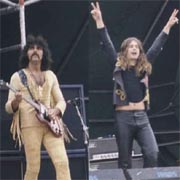
First bands like Blue Cheer demonstrated the distorted sound, then Iggy Pop and the Stooges brought proto-punk into the equation, then progressive rock bands like King Crimson and Jethro Tull expanded on the idea, and finally, Black Sabbath released the first heavy metal album in 1970, Black Sabbath. Following this, bands merged the Led Zeppelin style of Celtic folk-influenced hard rock with the Gothic horror movie soundtrack-influenced Black Sabbath, and created the first genre heavy metal, a rock hybrid which immediately began to typecast itself and drove the creation of underground metal with Motorhead.
Heavy Metal
Witchfinder General
1979-1987
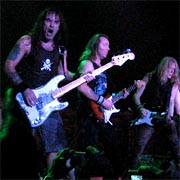
Heavy metal became popular in the 1970s and got absorbed by the hedonistic, individualistic, pleasure-seeking culture of the time. This produced a type of stadium heavy metalish rock that sold well but lost sight of the artistic ambitions of the genre. At the same time, bands like Motorhead and the Sex Pistols were popularizing the punk sound that had intensified since innovators like MC5, Iggy Pop and Link Wray began experimenting with it in the 1960s. In response, the more alert heavy metal bands added more gothic and neoclassical elements to distinguish themselves from the fray. The fusion of these two threads, hardcore punk and neoclassical heavy metal, produced an explosion of genres, but only two, speed metal and thrash, matured directly.
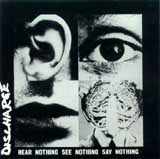
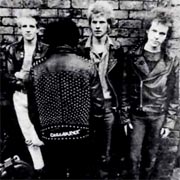 At the same time, starting with the explosion of the most nihilistic and yet thoughtful punk band to date, Discharge, releasing Hear Nothing See Nothing Say Nothing in 1982, new genres expanded in nascent form from 1983-1985. These were black metal and death metal, but they did not diverge into clearly distinct genres until later when the associations of death/deconstruction/structure and melody/Satan/emotion were established.
|
Black Metal Bathory Hellhammer Sodom |
Death Metal Master Slayer Massacra Morbid Angel Death |
Speed/Death Hybrids Rigor Mortis Kreator |
1988-1992
During the last years of Ronald Reagan's reign, when conservativism reasserted itself against the anomic search for meaning of a generation born into ideals it did not feel the nation upheld, the political conflict between these two forces heated up. Death metal, originally developed for the artistic vision that when death and horror are more real than individual moralization, people rediscover life, flourished, but also found itself under onslaught from gazillions of imitators. With the rise of Suffocation, a speed metal-influenced death metal band, the clones finally had reason to exist and so death metal exited in chorus of "me toos" as black metal rose from its ashes with a new sound and a less-tolerant ideology, just as the Soviet Union collapsed and the United States turned more liberal.
Death Metal
Black Metal
1993-1996
Death metal became a field of Suffocation clones, and bands increasingly turned toward either going "technical" to distinguish themselves, or assimilating themselves into mainstream styles like rock (Asphyx - God Cries), jazz (Pestilence - Spheres), funk (Mordred - In this Life) and punk (Pyrexia - Hatredangeranddisgust). At the same time, black metal rolled onto the verge of what would be the most popular style of metal to come from the underground, mainly because its primitive riffs and nocturnal melodies were part lullabye and part nightmare, apppropriate for an audience that was both aware of the decay of civilization but too disorganized to do anything about it. As soon as its popularity grew, especially with the release of that template for black metal from The Abyss, The Other Side, black metal too became inundated in imitators, although some late forming bands and middle era albums by classic bands helped flesh out its style and bring it to maturation.
Death Metal
|
Abomination Asgard Capharnaum Ceremonium Ceremony Cryptopsy |
Deeds of Flesh Hate Eternal Intestine Baalism Luciferion Mortem |
Oppressor Pessimist Rise Seance Thanatopsis |
Black Metal
1997-2008
 Since 1997, very little of vitality has occurred in metal. Black metal bands continue the style, either by attempting to expand traditionalism or "new" combinations made of black metal plus any number of already extant genres (some of the former are bad, all of the latter are stupid). Death metal continues with some absorption by metalcore and emo, which has created a queasily hybrid style that few fans of the older material want to hear, and many newer fans find too mixed for their tastes. What has radically expanded are the continuation of speed metal and neoclassical heavy metal, power metal, and the skipped generation descendant of thrash, metalcore, which reverses the thrash pattern by putting hardcore riffs into metal-style songs. The sub-genres are converging again by becoming more similar, which may enable newer acts to get more distance from convention and find a style in which writing makes sense.
|
Death Metal Acerbus Martyr |
Black Metal Conqueror Axis of Advance Averse Sefira |
The History of Heavy Metal Music: Ethnomusicology
| Era | Context | Music | Art | Influence |
| 1865-1949 | Populism | Rock | Individualism | Country, Celtic |
| 1950-1969 | Counterculture | Proto-Metal | Moralism | Prog, Jazz |
| 1970-1981 | Futurism | Heavy Metal | Hedonism | Electronic, Ambient |
| 1982-1987 | Reactionarism | Speed Metal | Humanism | Hardcore |
| 1988-1993 | Egalitarianism | Death Metal | Deconstructionism | Alternative |
| 1991-1996 | Egalitarianism | Black Metal | Deconstructionism | Alternative |
| 1996-PRESENT | Globalism | Retro-cumulative | Universalism | Hip-Hop, Techno |
Thesis
 Popular music was recorded and marketed as a Counterculture which opposed the normal, functional, and unexciting Culture that was dominant in society; by being outside of that which was in power, Counterculturalists argued, they were able to see what was "real" and to implement a "progressive" worldview in which moral correctness brought us gradually closer to a utopian state.
This marketing mirrored the process of adolescents, the main audience for popular music, who first reject the world of their parents, then once independent re-assess their own values, and finally, rejoin society on the terms of these recreated values. This determines "reality" as they will act to create it, based upon their values system.
While dominant Culture sought what was pragmatic, and Counterculture pursued the moral, metal music became its own movement because it could not agree with either of those approaches, preferring instead to try to seek what was "real," or meaningful and "heavy" (in the LSD-influenced vernacular of the time). Their approach did not aim at correctness, but assertion of subjective meaning.
 Early metal bands, in emulation of popular music as a whole, hoped to discover what was real by finding out first what was not. This attitude, over the course of four generations of music, took metal beyond the grounds of "good" versus "evil" into nihilism, where nothing had inherent value or classification, but could be described in terms of experience.
Nihilism is a frightening belief system for those in societies organized by dualistic (heaven versus earth) and liberal (individualistic, egalitarian) societies, as it denies that our values systems are more real than events in natural reality. To a nihilist, truth is a way we describe some things in reality, but there is no eternal life nor eternal truth which exists separate from immortality. Nihilism means accepting mortality, and experience as what we have in place of a religious or moral truth.
These ideas exceed limits of social acceptability, which in a capitalist liberal democracy threatens the self-marketing which individuals use to gain business partners, social groups and mates. As a result, metal was forced to wholly transcend the artificial consensual reality shared by Culture and Counterculture, and to create its own value system including its nihilism.
Seeking the real, and not the moral, this value system in turn surpassed its own nihilism by moving from a negative logical viewpoint to an assertive one, looking not for something objectively determined to be "eternal" but for that which will be true in any age past or present, discovering through personal experience and acceptance of nihilism (a symbolic analogue for mortality) that which society will not recognize, completing the process of adolescence in a state of actual outsidership.
Introduction
 Metal music began as the work of the youth born after the superpower age began, during a highly developmental period for Western civilization in which it, having defeated fascism and nationalism and other old-world evolution-based systems of government, considered itself highly evolved in a humanistic state of liberal democracy which benefitted the individual more than any system previously on record. During this era, society served citizens in their quest for the most convenient lifestyle possible, and any questions or goals outside of this worldview were not considered: it was considered a "progressive" continuation of human development from a primitive evolutionary "red in tooth and claw" state to one in which social concepts of justice and morality defined the life of the individual. The individual has triumphed over the natural world, and faces none of the uncertainty of mortal existence brought about by physical competition and predation.
Politically (the global quest for egalitarian society) and socially (the empowerment of new groups and loss of consensus) humanity viewed itself as getting ahead and being superior to other forms of civilization, including the equally egalitarian but totalitarian Communist empires of the Soviet Union and China, but as the thermonuclear age dawned in the 1950s, this dichotomy came to define the "free West" as much as its enemies.
 The first generation after WWII created early proto-metal in a time when all older knowledge and social order was being overturned in the wake of an impulse to redesign the world to avoid the "evils" of the previous generation. The people of this age, and coming ages, were new in that they could not recall a time of direct experience of nature as necessary; the grocery stores, modern medicine and industrial economies of their time took care of all of their needs, and no unbroken natural world could any longer be found except on specialty tours. Their civilization had become exclusively introspective and was losing contact with the (natural) world beyond its self-defined boundaries.
During this time, a "peace" movement which embraced pacifism and egalitarian individualism was gaining popularity at the forefront of the counterculture, a phenomenon which had existed since in the 1950s smart marketers (namely Allen Freed) had promoted rock music as an alternative to the staid, traditional, monogamous and sober lives of Protestant, Anglo-Saxon Americans. With WWII polarizing the world against first German and later Russian "enemies," and Viet Nam revealing the moral bankruptcy of benevolent superpowers motivated by their economies, society was becoming more dependent upon the ideological tradition building over the last 2,000 years: focus on the individual, or individualism, as politically expressed in egalitarianism and liberal democracy. This was expressed in both culture and counterculture.
In contrast, metal music emphasized morbidity and glorified ancient civilizations as well as heroic struggles, merging the gothic attitudes of art rock with the broad scope of progressive rock, but most of all, its sound emphasized heavy: a literal reality that cut through all of our words and symbols and grand theories, to remind us that we are mortal and not ultimately able to control our lifespan or the inherent abilities we have. This clashed drastically with both the pacifist hippie movement and the religious and industrial sentiments of the broader society surrounding it.
Philosophy
This was a confrontation with the "abyss" as first described by existentialist F.W Nietzsche: the awareness that life is finite and of functional, transactional maintenance; that we are both predator and prey, and that we have no control over our lives or death. To Nietzsche, and thinkers such as Arthur Schopenhauer before him, to realize this was an "undergoing," or embracing of nihilism: the belief that there is no value other than the inherent, physical interaction of the natural world. To a nihilist, there is no inherent morality or value, thus there is no reason to view social status and financial success as ultimate goals, only as methods to a path ranked by subjectively-derived importance. This view threatens the beliefs and punishments used to hold Western society together since roughly AD 1000.
Regardless of benevolent social objectives, Nietzsche argued, religion and society were cults that banished death through the "revenge" that morality offered in giving the individual a vector by which to be "better" than the world itself, and by being "equal" to all others, immune to comparison (a symbolic form of predation triggered by Charles Darwin's arguments on "survival of the fittest). In essence, Nietzsche saw social behavior itself as an enemy of reality recognition in the individual and thus, like morality, an ingrained influence that would prompt rebellion and instability within a society that would know no other recourse than moral norming.
Heavy metal, as the music most visibly fascinated with death and suffering (and most likely to mention Nietzsche), addresses the sublimated issue of Nietzsche's abyss in Western society, which has based its founding principles and individual social and mystical values upon the polarity of "good" and "evil," is an identification with the enemy. In the Judeo-Christian view, death and suffering are an enemy which is banished with "good" behavior in the hopes of heavenly (and earthly) reward. In secular form, egalitarian capitalist liberal democracy "empowers" the individual and gives him or her the moral "freedom" to act without regard for the natural world, thus being immune to predation and any form of assessment outside of the social and fiscal. When one embraces the breadth of history (outside of the current civilization), the nihilistic lack of eternal presence of value, the predominance of death and predation, and the logic of feral impulse, one has directly challenged both modern capitalist liberal democracy and the extensive religious (Judeo-Christian) and secular (liberalism) heritage upon which it is built.
8,000 years before Christ there was a religion in Northern India which addressed these issues in a sense without dualism; it believed that life is known to humans through sensual (eyes, ears, taste, smell, touch) perception of a reality composed of ideas which was similar in structure to both nature and the process of thought itself. In this religion the Faustian spirit was clearly present, as while a heroic deed was more important than survival, personal mortality was clearly affirmed. Thus there was both meaning and death, and no absolute God or Heaven to reconcile the two. This required the individual to declare values worthy of filling a life, and worth dying for, and from this origin the ancient heroic civilizations were spawned. Metal's belief system is closer to this than to any modern equivalent, thus it is sensible to posit a closure of the cycle and its renewal in the ideas gestured by heavy metal music.
Music
Art does not exist in a vacuum within the minds of its creators. If a concept is applied to music, there is a corresponding concept in structure and the worldview of the artist that creates the frame of mind in which the artist creates music which sounds like its desired value system. Art is too complex to be created without any prior thought as to what it expresses; this concept is common in literature and visual art, but ignored in popular music (perhaps because in most popular music, the concept - and the music - reflect crass materialism and futile neurosis and not much else).
At the end of an age of moral symbolism and technological norming, metal is recreating the language of music to reflect heroic values, formulated from the nihilistic mandate of "now that you believe in nothing, find something worth believing in." The ease of social and political identification found in rock music is eschewed, as are aesthetics which endorse the myopic neurosis of first world lifestyles. And while metal has evolved over several generations, several musical facets remain the same, suggesting a corresponding shared conceptual underpinning.
This "design form" of metal differs from popular music in one simple way, but from this arise any number of techniques and attributes which allow composers to create in this method. Its primary distinguishing characteristic is that metal embraces structure more than any other form of popular music; while rock is notorious for its verse-chorus-verse structure and jazz emphasizes a looser version of the same allowing unfetter improvisation, metal emphasizes a motivic, melodic narrative structure in the same way that classical and baroque music do. Each piece may utilize other techniques, but what holds it together is a melodic progression between ideas that do not fit into simple verse-chorus descriptors. Even in 1960s proto-heavy metal, use of motives not repeated as part of the verse-chorus cycle and transitional riffing suggested a poetic form of music in which song structure was derived from what needed to be communicated.
Synthesis
 In this structuralism, metal music asserts a concern for the underlying mechanism of the universe as a whole, instead of limiting its focus to human social concerns. This degrades the public image fascination begun in the West with absolutist morality; in its use of power chords, the most harmonically flexible chord shape, and a tendency toward melodic composition, metal music emphasizes an experience, where rock can articulate at best a moment and then put it into a repeating loop. While rock uses more open chords and aesthetic variation, its outlook is ultimately a utopic form of the counterculture: progressive trends leading to some ultimate state of an absolute, such as "freedom" or "joy" or "popularity."
By way of contrast, metal music is a portrait of the post-humanist mindset: concerned more about natural reality than social symbolism, addressing experience instead of moral conclusion, and, when it seeks a context of meaning, oriented toward the subjective experience than an "objectivity" derived from shared societal concept. It is aware that leaving behind the comforting alternate reality of social assessment returns to a natural state in which the individual is ranked among others according to ability, much as predation did years ago, and is forced to accept mortality and limits of personal control. This thought demonstrates the modern era of Western civilization facing the ideas of the ancients while eschewing the consensual social reality of industrial capitalist liberal democracies, and, as said societies collapse from lack of consensus, a potential future direction for Indo-European culture
Period 1 [ 1865 - 1949 ]
In this age, America matured from its beginnings into the bureaucratic complexities of a modern republic, decided on its unifying concept, and consequently, experienced demographic and social change.
Having been formed in 1789 on a compromise between those who wished to remain colonies and those who wished for a centralized federal entity, the fledgling nation had resolved few of its internal disputes in part owing to the chaos of its birth and the ongoing warfare that afflicted it as late as 1812. Having dispatched this, it began attempting to find consensus among the disparate viewpoints that had not found home in a Europe wracked by internal religious infighting descended from the conflicts of the middle ages.
History [ Populism ]
As the nation-state of America expanded, especially toward the West, there was an increasing need for governmental intervention to resolve disputes (seen by the republic as transactional) between settlers and Indians, settlers and each other, Westward republics and the banks that owned them back east. This required a commitment to a bureaucratic entity, which in turn required central authorities and standards.
The result was, after some internal peregrinations, a Civil War not fought over the issue of slavery (as asserted in middle school textbooks) but the issue of state's rights: was the United States a confederacy of small independent nations, or a republic made of states which were essentially local variants on the order imposed by a strong central government? The latter prevailed due to the industrial supremacy of the northeast; this would be a central theme in most American wars.
Once this concept had been decided, it was over the next forty years unified by an expansion of the founding concepts of the nation in accordance with the decisions of the Civil War. The highest power was the Federal State, but the Individual was its currency, and therefore America came to embrace its image as the "melting pot" in which the "poor, huddled masses" might find refuge. As a result of this new marketing, America invited and enfranchised new groups of people, starting with recently-freed African slaves and continuing to an acceptance of previously unwanted immigrant groups, such as Irish/Scots, Italians, Jews and Slavs.
Because of this change, a shift in alignment occurred that would plague America in the coming years: the original Northern European population of America, now seen as the top dog in a complicated caste system, began to isolate itself through financial and social means from successive waves of newcomers of fundamentally different cultural, ethnic and religious backgrounds. This was contrasted by an egalitarian movement to accept these people and "diverse," or non-collectively-consensual ideas into the mainstream; as time passed, this movement became known as the counterculture, but that could only occur after World War II, when the country was united in temporary consensus by a shared enemy.
As a result of these social changes, American ideology underwent public change. Where it had once been an elitist nation designed for those who could rise above the need for a normative social order, it became an inclusive and facilitative society whose greatest degree of commonality was a desire by its new and old populations to rise in class rank through the earning power afforded by a vast industrial civilization. Over time, this view, in which society pandered to the diverse and non-consensual individuals for the purpose of "empowering" them to be socially equal, earn money and become autonomous agents of wealth, became known in a generalized sense as "Populism."
Music [ Rock ]
One cannot contemplate rock music without viewing its roots; that being said, its roots cannot be viewed without analyzing their origins in turn, and the political circumstance which shaped their public image.
Derived from English drinking songs, Celtic folk music, German popular music including waltzes and the proto-gospel singing of Scottish immigrants, "country folk" music had been an aspect of American culture since the early days of the Republic, but as it existed in country and not city was rarely recognized by cultural authorities of the day. Further, once new populations became empowered and replaced the old, most of this history was forgotten.
In part, the reason for this was political: the members of society who advanced American popular music as an artform were not of the original Northern European population, nor were they disposed toward thinking benevolently toward the same; further, they needed to invent something which, like advertising throughough the 1950s, presented itself as an oppositional alternative to the "traditional, boring" way of doing things (early advertising extolled the virtues of its products, while later advertising promoted products as part of a lifestyle which had to demonstrate both novelty and uniqueness to have value as a replacement for the traditional, boring, and otherwise effective way of doing things; this transcendence of function for image has fundamentally shaped American character). As a result, the mythos of blues as a solely African-American artform, and the denial of the Celtic, English and American folk influences on both blues and rock music, was perpetrated as a marketing campaign with highly destructive results for all involved.
The blues was not formalized until it was recorded, and at that point in time, a fixed structure was imposed on it based on the interpretations of others. Broadly stated, it used a minor pentatonic scale with a flatted fifth, constant syncopation, and distinctive "emotional" vocal styles. Of all of its components, none were unique, nor was its I-IV-V chord progression unique to the blues. To view it from an ethnomusical perspective, the blues is an aesthetic (not musical) variation on the English, Scottish, Irish and German folk music which made up the American colloquial sonic art perspective since its inception. From a marketing perspective, however, the blues had to be marketed as a revelation from the downtrodden and suffering African-American slaves, so that it might maintain an "outsider" perspective which, to people bored with a society based on money and lacking heroic values, might appear more "authentic" than their own.
When country music was re-introduced to the then-standardized blues form, the result was called rock music. Its primary difference from country was in its use of vocals which emphasized timbre over tonal accuracy, and the adoption of a more insistent, constant syncopated beat. While German waltz and popular music bands had invented the modern drum kit and developed most techniques for percussion, their music and that of their country counterparts in America tended to use drums sparsely, much more in the style of modern jazz bands than in the ranting, repetitive, dominant methods of rock music. However, it is hard to find someone in a crowd of mixed caste, race, class and intellect for whom a constant beat is intellectually and sensually inaccessible, so it was adopted as a convention. Much as the standardization of the blues took diverse song forms and brought them into a single style, rock swept a wide range of influences into a monochromatic form.
Some historical backfill is worth noting here. The Celtic folksongs of Ireland and Scotland had two main influences: the pentatonic drone music of the Basque-Semitic "natives" of the UK, namely Scythians and the diverse groups forming "Picts," and the Indo-European traditional music which is continued in India today. The melodies, including pentatonic variations of many different forms (many of which include the flatted fifth or modal analogue), are almost contiguous such that a player of Indian classical music and a Celtic folklorist can complete each others' melodies in the traditional manner. Similarly, pentatonic music also derived from the Indo-European tradition was present in Germany, most notably in the biergartens and public ceremonies requiring simple music that everyone could enjoy. These musics employed improvisation, as did classical playing from the previous four hundred years; when these historical facts are recognized, American popular music can be identified as the marketing hoax that it is.
The consequences of this hoax have been a persistent blaming of white Americans for "stealing" a black form of music that never existed, and in return, a condescension toward traditional forms of music of all races that became identified with, and scorned as, a black form of music. As we shall see, marketing has both shaped the American experience and contributed to longstanding internal conflicts without resolution. In terms of popular music, marketing is important precisely because it insists on standard forms; they are easy to reproduce without requiring any particularly unique talents on the part of performers, producers, marketers or audience. This has caused an increasing simplification of music while marketing has grown correspondingly more savvy and, like American advertising as a whole, has grown away from focus on the product to focus on lifestyle associations unrelated to the product.
However it arrived, blues-country became "rock" in the 1930s-1950s mainly because of technology. Adolph Rickenbacker invented the electric guitar in 1931, and recording equipment advanced from the primitive to the cheaper and more portable units brought on by vacuum tube and then transistor technology. Additionally, microphones improved, especially those which could capture the nuances of voice. Louder guitars and vocals required the simple shuffle beats of blues drumming to gain volume, prompting a revolution in drum kit assembly. As a result, the simple blues-country hybrid became a marketing standard known as "rock 'n' roll," then "rock," as it was absorbed into the American mainstream. The earliest bands lacked much in the way of style, but wrote complacently harmonizing pieces based on the European popular music of clubs in the 1930s (much of jazz is based upon the same music). As time went on, the stylings - appearance, performance and cultural positioning - of the music became more advanced, and the songs themselves became simpler and more like advertising jingles.
Art [ Individualism ]
If one thread had to be described in the art of the era as rising parallel to Populism in the political and social consciousness, it would be Individualism: the belief in the decisions and desires and needs of the individual as the most important value held by humans, especially in the context of "lifestyle choices" which involve the purchasing of products. Much of this relates to the desire of new American immigrants to both fit in and be accepted for what they were, as, lacking the cultural affectations of Northern Europeans, they demanded a "tolerant" society such that their own customs might not come into conflict with any dominant or consensus-oriented cultural standards. Thus non-consensus became consensus through the vehicle of absolute individual autonomy, and a depletion of any standards for the goals of individual behavior.
When the religious impetus to America first developed, it was in the form of settlers escaping the imperial sentiments of a Europe united by Christianity; after one thousand years of wrangling in which the mostly Judaic-Buddhistic doctrine of early Christianity had been replaced with the Euro-Brahminic doctrine of Catholicism, the continent had accepted the modified religion and begun the process of bringing disparate cultures and peoples under its yoke. As government became necessary, it followed a pattern of allowing universal non-consensus (a process similar to the autonomy granted the individual by moralism, which places not harming others as a higher value than finding the right answer for all people) which accelerated after the Civil War, as it needed to justify its crushing of those who wanted America to be a loose confederation of countries with different rules and customs for each, and after WWII, when America had to justify her total war and nuclear engagement against "totalitarian" empires by coming up with a better marketing slogan, namely the "land of the free" rhetoric. Thus individualism travelled from a minor technique of asserting independence from the dominant religious tradition of the mother continent to a justification for global military and cultural supremacy.
Art did not escape this influence. As art is a mental process that, if the artist wishes to survive on his or her skill, produces a salable physical entity, public and popular art by definition must find something to sell to its audience, usually by exploring concepts with which they are familiar and enamored. For this reason, in capitalist liberal democratic societies especially art tends to follow the trends of each era, and in America, art has gone from being of the elitist classical music and fine arts tradition of Europe to having a distinctly popular flair, reflecting the individualistic concept that no idea can be judged by collective standards, and thus that like individuals all art and all perspectives are "equal," and have no meaning except aesthetics; thus if art appeals to one for sentimental or visual reasons, it is more important than any transcendent meaning it might attempt to convey. This individualism shaped the stylistic aspects of rock'n'roll more than any other single force.
Influence [ Country, Celtic ]
Country, Folk and Celtic music originally had a diversity of forms but under the influence of rock music, became increasingly closer to the standard rock form while feeling the pressure to change stylistically. In this the normative influence of monochromatic forms such as rock music is seen.
Period 2 [ 1950 - 1969 ]
 When World War II broke out across Asia, Europe, and finally the Americas, there was at first confusion as to how to portray this war. A world already sickened by the first World War and the Great Depression was inclined toward non-interventionist policies, favoring sticking close to home and fixing local problems (the Depression having run for a decade, most countries were starved for social services and public works that had lapsed during that time). Ultimately, what leaders and propagandists alike made the tone of their argumentation was the concept of the "free world" versus leaders who were seen as arbitrarily totalitarian. Where before World War II, Hitler was seen as an ideologue who would use any method to achieve his ends, in the hands of US propagandists he became an insane man lusting for power who would use ideology to justify his ends (the same was done to Tojo, Mussolini and later, in a case in which it may have been accurate, Stalin).
History [ Counterculture ]
The result of this propaganda was to consolidate the different aspects of egalitarian philosophy in the West into a single imperial doctrine, that of bringing "freedom" of individualism to an (obviously) otherwise "uncivilized" world, thus justifying the right of America and her allies to engage in any warlike practice that suited them against nations which did not uphold the capitalist liberal democratic government, widely held to be the most "empowering" and "moral" form of government. Whether fighting godless Communists or the "Hitlerian" nationalist Milosevic, the Americans - and their allies of liberal powers including wartime partners the UK and Australia - felt themselves justified in waging war for the reason of bringing capitalist liberal democracy to the "people" of distant homelands. This was in many ways parallel to COMINTERN, or the Communist movement to "empower" workers worldwide with Communist societies.
However, the first tremors of uncertainty cracked this facade during the years following WWII. First in Korea, and then in Viet Nam, the Americans faced wars of murky practices and equally murky outcomes following the doctrine of "Containment," by which Communism was blocked from gaining a foothold across the world. As it turns out, Containment was not incorrect, for Communism or any other system, as industrial powers tend to influence their neighbors through gifts of weapons and financial aid (carrot) and military intimidation (stick). The Vietnam war brought this uncertainty to a head in 1968 during the Tet Offensive, when an American public who had been assured by their TV sets that the Vietnamese Communists (NVA/VC) had been all but beaten suddenly witnessed a Communist force of unpredicted size and strength swarming from all corners to attack a demoralized, racially-divided and drug-addicted US military. The result was politically contained, later, but it was clear to most alert observers that American doctrine was facing a major challenge both externally and surprisingly, internally (it took two decades before a liberal president, Bill Clinton, would apply the same policies with limited success in Yugoslavia and Afghanistan).
The result of this doubt and political posturing was most profound in America. In the 1950s, Beats and other cultural insurgent groups cast aspersions onto the traditional American way of life, one which had in the 1950s become accessible to the second-tier European populations such as Italians, Irish/Scots, and Slavs (all historically less favored because of their racial mixture, in the case of the Italians, Arabs, the Irish/Scots, Scythians and other middle eastern groups, and the Slavs, Mongols, Gypsies and Jews). When the Beats faded toward the end of the 1950s, they had been statistically insignificant except in academia, which meant the next generation of teachers in the 1960s were well-versed in Beat and liberal orthodoxy, and taught it to students from age 13 onward. Consequently, the youth coming of age in 1965 were aligned against the religion, social practices and values of their parents, and burst into full flower as a "Counterculture" whose primary doctrine was that opposition in the name of traditional American values of liberty, equality and fraternity applied to disenfranchised populations from African-Americans to American Indians to Jews and Homosexuals. These groups united under the Countercultural banner to become a force that assimilated American liberalism and redirected its agenda to empowerment for all, once it became dominant. However, before it gained any social status, it had "outsider" authenticity and cachet which made it a sought-after cultural force across the West, in part because of its contrarian status and its lack of acceptance among the cultural and social mechanisms of the day.
Music - [ Proto-metal ]
Since 1950s rock had been such whitebread wholesomeness, centered mainly around puppy love and going to the beach or the sock hop, the revenge of those who had been left out focused angrily on dissident and alienated themes, but expressed them to some degree in the civility of the day, leading to forms that in our current time of literal and material thought are tame, but in their time were offensive by the nature of their existence. These came in three forms, one crude, one arty, and one technique-oriented.
 The first was the advent of loud, distorted blues, which was pioneered by a mess of a band called Blue Cheer, who made braying, droning, grinding blues rock with the aid of deformed amplifiers and a passion for crudity. They were the vanguard of a range of electric blues bands from Cream to Jimi Hendrix to ZZ Top, and inspired much of the loud rock which followed, including proto-punk-rockers the Kinks and the Who. Much can be said about these bands, but what is most important is that they took the traditions of folk and blues improvisation and turned them into something technically on par with the jazz and big band acts of the day, adding guitar fireworks and lengthy songs to a genre that was otherwise strictly radio-play ditties.
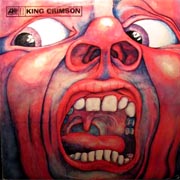
The second tine of the fork was progressive rock, which in 1968 found its most extreme act in King Crimson, but which truly flowered during the early middle 1970s. Arguably, this genre was given impetus by a band overmentioned in any history of popular music because they were among the first to leave standard rock format, overcoming its novelty, namely, the Beatles. Their work was one of many that allowed bands to mix classical and jazz training into their rock, resulting in longer song structures, many of which were narrative or neo-operatic (Camel, Genesis, Yes) and the use of distortion and dissonance in artful ways. While these bands ultimately choked on their own "virtuosity," being nestled in a genre that could barely appreciate them but not reaching the level of complexity of classical works (in part because of a need to service the unending drumbeats and syncopated rhythms common to rock), they lived on in contributions to other genres.
Finally, there was a tradition of bands who grew from the surf and garage rock traditions into a technique-oriented neo-proto-punk-rock format, beginning with half-American Indian guitarist Link Wray and leading through surf guitar champion Dick Dale, both of whom were users of distortion. Psychedelic bands such as the 13th Floor Elevators and semi-punkers like Love and The Trees are worth mentioning here, but these bands had a foot as well in inspiration from the first dark rock band to exist, the Doors. Where other rock bands had focused on love or peace, the Doors brought a Nietzsche-inspired morbid subconscious psychedelia to rock music, and were the origins of much of the neo-Romanticism which later bloomed into metal, as well as many of the more inspired moments of progressive and punk rock.
By 1969, the influence of these artists had saturated the forms of public consciousness which were focused on rock music as a developing artform, and contributed to the explosion of hard rock (Led Zeppelin, Deep Purple) and proto-metal (Black Sabbath), both of which occurred simultaneously to the development of distorted, power-chord based technical music from King Crimson. This year was thus the watershed for loud forms of rock, as it started three threads which would run concurrently during the 1970s and hybridize in the next decade.
 In many ways taking up where the Doors left off, Black Sabbath were originally a British electric blues band named Earth, but after guitarist Toni Iommi had a stint in progressive rock band Jethro Tull (and not coincidentally, members of Led Zeppelin and Black Sabbath participated in each other's projects), the quartet surged foward with a new sound, inspired by horror movies and the same morbid, neo-Gothic animal nihilism that had made the Doors strikingly out of place. Using perhaps the most extreme distortion heard so far, and reducing the flowery instrumentalism of the time to the basics, Black Sabbath combined progressive rock with electric blues and created something that differed from its contemporaries in several ways: it almost exclusively used power chords; it used bassier distortion; it had narrative song structures like a progressive band, but relied on gut-simple riffs for the majority of its air time; it was morbid, occult and negative in its lyrical outlook. For all of the political change fomented by 1960s rock, Black Sabbath were a shock -- but even more surprising was their consequent success on radio and in record stores. They had tuned into something their worldwide audience found relevant, if not appealing.
Legend relates that the members of Black Sabbath, looking for a new "angle" (trend) in rock music, drove past a marquee for the horror movie titled Black Sabbath in English speaking countries. H.P. Lovecraft, arguably the founder of that genre, once stated that in life he had not observed good or evil, but an abundance of horror - meaning that there was no moral classification for the "bad" things that happened, but that the experience would be horrific. Black Sabbath as a band, in adopting their new image, sought to express the experience of horror and truth, eschewing for a moment the rigid morality of rock bands around them.
 It is important to note that most of this occurred with notice - by the members of Black Sabbath. They wanted to be musicians and fit in somewhere between power blues and progressive rock, and despite drug use, psychological mishaps and basic personal instability, they created a "sound" that was ahead of its time - and ahead of its musicians. Much less articulated than Led Zeppelin (and farther from the rock norm of the time), they launched themselves ahead of the crowd and then had to look back and gather some sense of direction, causing the band to collapse artistically by 1978. At that point, however, the formula for 1970s heavy metal was established: a smidgen of the King Crimson esoteric weirdness, the dark Gothic haunting cavernous sound of Black Sabbath, the guitar wizardry of Deep Purple and Led Zeppelin, the physical thunder and brash insane hedonism of Blue Cheer. At this point in history, "heavy metal" (a term borrowed from beat writer William S. Burroughs' 1962 novel, The Soft Machine) was viewed as somewhere between prog rock and psychedelia, but already its content was starting to differentiate itself.
Primarily, mainstream radio music will always follow the same song format that was the basis of the English drinking songs and Scots hymns that inspired the blues, including some degree of instrumental vocal shadowing ("call and response"), repetitive verse chorus form, and a bridge taking the song to a brief melodic counterpoint and then resolution. The more intricate Black Sabbath songs were thus mostly lost to radio, encouraging any artists wishing to develop those concepts to do so elsewhere. Further, the morality of the time and the counterculture was offended by the occultism Black Sabbath had chosen as an aesthetic image, yet had found it loomed larger than life (aided by the semi-serious occultism of Led Zeppelin's Jimi Page). Occult beliefs are distinguished from "normal" (Christian, Jewish) religions by the occult's tendency to accept good and evil as forcing balancing the universe, both being necessary, as in the gnostic tradition. This doesn't sit well with church elders nor with Counterculture members trying to come up with a universal, absolute reason why change and empowerment of the less-fortunate must occur. Years later, even highly political punkers were often skeptical and repulsed by the amorphous, indefinite stance of heavy metal, as if they fear the reaction of an occult mystic to their rule-based logic.
Art - [ Moralism ]
 During this era, in which the superpowers re-aligned themselves internally to justify their violent projection of individual "freedom" upon the world, as a consequence of their competition with the Communist empires of Russia and China, the primary goal of Western art was to glorify the individual and the choices it faced approaching "freedom" in an industrial society. Jazz rose into the mainstream and took on new forms, most notably the harmolodic (free harmony) of Ornette Coleman and the consequent adoption of that technique by John Coltrane, as a coda to hard bop. Mainstream film and literature both praised the individual and its range of choices, and warned of possible confusion in this new society. Don DeLillo's 1972 novel White Noise is emblematic of this tendency, in that it both explored the importance of each individual life and warned about a lost span of consciousness in a world of brands, constant distractions, entertainment and cities which were more like machines than dwelling areas. Thomas Pynchon's novel of the years following, Gravity's Rainbow, warned of the moral - individualistic - consequences of too much technological thinking. Some years before, William S. Burroughs' Naked Lunch had suggested that society operated according to an "Algebra of Need," in which the drug seller's dependency on his client's dependency was compared to the system of capital itself. While these books were highly critical of society itself, their criticism was based in liberal democratic thought and the importance of the individual, which made them both critics and collaborators in the society of the time.
Naturally, in popular music, this formula was pared down quite a bit. Most music was still about love, but it had gone from "puppy love" to "serious" adult love to the concept of love as political activism, in a neo-Christian belief that if we embraced all people equally, peace would reign on earth. While to anyone from the 1990s or later this concept is all but a punchline, at the time a less experienced society found it a welcome respite from the Cold War and the balance of power between two nuclear-tipped adversaries. In the vision of the music of the time, now labelled "classic rock," a moralism of the individual could prevent the abuses of the past, and thus by process of elimination, have solved the problems of the future.
The world saw the postwar order of superpower rule fade as the failures of Vietnam and the cold war culminated in a lack of faith in previous ideologies. The hippie generation, as an appeal to values inherent to the American political dialogue since the writing of the Declaration of Independence, was a culmination of internal stress in the democratic, neo-liberal, individualist political climate of America. While claiming ourselves to be liberators, detractors argued, we were shepherding our own third world with segregation of the oppressing and subjecting ourselves to a social order that put a monetary/political value on lifestyle, sex, and desire. America - the great savior of Europe during World War II and the world policeman for commercial hegemony - confronted her own hypocrisy in the rice fields of Viet Nam and the crowded race riot kindling of America's ghettoes.
Influence - [ Prog, Jazz ]
If one were to diagram the influences between metal and progressive rock, it would resemble a game of Pong more than anything else, as any idea one had would quickly influence the other, in part because early hard rock bands such as Deep Purple and Led Zeppelin had "virtuosity" and harmonically advanced music which put them in roughly the same league as bands such as King Crimson and Camel, mainstays of the progressive rock era. Hard rock bands didn't tend to be as "weird" or venture as far from the conventionally accepted song format, as their audience was less art-school and more blue collar. However, the influence occurred, and through prog rock was absorbed quite a bit of jazz and classical theory as well. (An influence also came from Roma guitar player Django Reinhardt, who like Black Sabbath guitarist Tony Iommi was limited in motion to only two fingers on his fretboard hand.)
Period 3 [ 1970 - 1981 ]
The world saw the postwar order of superpower rule fade as the failures of Vietnam and the cold war culminated in a lack of faith in previous ideologies. The hippie generation, as an appeal to values inherent to the American political dialogue since the writing of the Declaration of Independence, was a culmination of internal stress in the democratic, neo-liberal, individualist political climate of America. While claiming ourselves to be liberators, detractors argued, we were shepherding our own third world with segregation of the oppressing and subjecting ourselves to a social order that put a monetary/political value on lifestyle, sex, and desire. America - the great savior of Europe during World War II and the world policeman for commercial hegemony - confronted her own hypocrisy in the rice fields of Viet Nam and the crowded race riot kindling of America's ghettoes.
History - [ Futurism ]
 In chasing the symbols of peace, happiness, love and tranquility, the "youth counterculture" of the 1960s and 1970s embraced its oppressors and soon the peace sign became another icon of commercial culture. In the absence of ideology behind the dissipating hippie movement, technological futurism without ideological structure mated the sensual lifestyles of the 1960s with the commercial values of the 1940s, leading to a vapid culture which quickly assimilated anything however rebellious into its stream of social entertainment. The unstoppable machine of basic commerce which had been untouched by the hippie revolution began to justify itself with morality while increasing the benefits of first world living. Free love became swinging, experimentation became a steady diet of drugs, and ideology turned into coffee table discussion. By these mechanisms the 1970s became a futuristic decade, or one in which belief turned toward the future and technology as a savior where ideology had petered out, paving the way for a decade following which would affirm the industrial revolution as its own value system.
During the 1980s, the only relevant symbols were monetary and social success, meaning a modern adaptation of the white picket house in the suburbs, the minivan, local church and school groups and happy children with no cares in the world. A decade of overextension and massive expenditure on cold war buildup shattered most of this and replaced it with a literal reality of subservience, slowly flipping the power balance to a sublimated leftism. As the smiley futurism came to a close at the turn of the eighties it was clear the alienation was not an affliction but a condition of the system, and more extreme responses arose. Both the old-school conservative system and the hippie "revolution" had failed in their aims. In the mainstream, the previously "new left" leanings of our culture were overshadowed by the pragmatism of gaining money and power, and in the underground, a new series of dissidents found themselves in desperate paranoia against the industrial society slowly surrounding them. Slowly, the pragmatic "eat and assert needs" conservativism of America flowered with Ronald Reagan, and the underground new left moved toward media and went mainstream to combat the money and power of old school interests.
Metal - [ Heavy Metal ]
Metal began in prototype form with Black Sabbath, whose trademark occultism symbolized life in terms of the eternal and ideal, while their gritty, sensual, lawless guitar gave significance to the immediate and real. The resulting fusion of the bohemian generation with a nihilistic, dark and morbid streak birthed early metal. Those who had rejected the hippies and found no solace in social order embraced this music and lost bohemians everywhere began to find new directions in this sound.
 Having been thus born of the rock tradition early metal remained much within that framework, with dual lineages existing in Black Sabbath, the proto-metal architecturalists, and Led Zeppelin, the blues-folk-rock extravagantists. While the 1970s struggled to develop further the innovations in rock between 1965-1969 the influences that hit metal were primarily from European progressive rock. These musicians used classical theory to give narrative context to themes which in the popular music style repeat through cycling short complementary phrases or riffs which center motives. This technique migrated classical styles adapted from acoustic guitar and espoused structure over total improvisation.
As metal grew in the middle 1970s, its fragmented nature brought it both commercial success and hilarity as a retarded younger brother to rock. The rock side coupled with trash rock bands and formed stadium metal, which was the apex of metal's popularity and the nadir of its creativity, with bands being known for musical illiteracy, hedonistic excess and often mind-wrenching stupidity in interviews. These bands would come into full flower in the 1980s, but marked their territory well before the turn of the decade. On the other hand, however, some of the most dramatic growth in metal occurred when bands merged progressive leanings with desires for traditional solid, sing-along songs.
From this fork in the metal path came three greats whose influences cannot be underestimated, birthed in the early 1970s but becoming most dramatically influential in the 1980s: Judas Priest, Motorhead, and Iron Maiden. Each had musicians from a progressive background who added new ideas to rock and metal, whether the neoclassical guitar duo of K.K. Downing and Glen Tipton or the melodic basslines of Steve Harris of Iron Maiden. Even Motorhead, the simplest and most basic of the three, wrote songs with a melodic baroque tendency that rivalled that of the Beatles, except without the flourishes and happy feelings. Bridging between psychedelic space rock like founder Lemmy Kilmister's Hawkwind, aggressive punk and simplified metal-rock in the style of Blue Cheer, Motorhead sounded like a glass-gargling vagabond and an impromptu jail session band, but developed much of the technique and basic riff forms for the hybrid music to come.
The more obscure and threatening NWOBHM bands grew with the subgenre in the 1970s to oppose commercial slickness with direct and primal music. Angel Witch and Diamond Head and eventually Venom tore technique to its basics to get to the ballad-meets-firefight balance of rebel music. All of these fused the DIY attitude of punk bands with the epic nature of metal and created as a result music that was bold and far-reaching but accessible, both to fans and to those who would like to pick up their own instruments and emulate it.
Art - [ Hedonism ]
"People are kidding themselves when they think music is going
to change the world or enlighten people. It's a bunch of hogwash."
-- Paul Stanley, Kiss
 The 1970s brought an era between the peace love and happiness age and the more serious years to follow; as the Cold War intensified and the threat of ICBMs became more pronounced and definitive, the 1970s were privately a grim time of preparation for the worst and publically a time of vast hedonism. Part of this existed because underneath the hopes of the last generation had been a vast despair, in knowing that force would solve what pleasant thoughts of peace and universal love could not; part of this occurred because the movements of the 1950s had run their course for a generation without finding anything new. Hippies were essentially Beats with a more artificially positive outlook, and rock'n'roll had run itself into redundancy, relying on extremity to make itself something other than mundane.
The result of this pursuing tangible heights in a void of actual belief was a profound hedonism. Casual sex reached the mainstream, as did drugs including more powerful variants of marijuana and cocaine. The futurism of a commercial society replaced ideas with lifestyles based on products, conspicuous consumption, and the Me generation at its most flagrant. The result was that most fell into mainstream lockstep, having absorbed the methods of the previous generation but lost its belief; the dissidents in art were hardcore punk, ambient and electronic music.
Influence - [ Electronic, Ambient ]
From the public front, the Sex Pistols exemplified all that hardcore was: brash, loud, and in total nihilistic denial of almost all value (except curiously being anti-abortion, since even punk vocalists find it hard to shake past indoctrination). For every band that was a public face on punk however there were garage bands and hardcore bands which labored in obscurity, rarely recording much that survives to this day, in part because their attitude toward musicality was so dismissive that their one- and two-chord songs had few fans except those caught up in the cultural movement itself.
In ambient music, musicians such as Tangerine Dream and Robert Fripp probed a new form of spirituality in pieces that eschewed the obvious, tangible and quantifiable sounds of traditional rock instrumentation, preferring instead lengthy pieces which slowly developed through layers of atmosphere and contained a poetic content of revelation, much as classical pieces progress through motives to uncover an essential melody or inspiration. They were echoed in this by electronic musicians such as Kraftwerk, who originated the genre when it was necessary to be able to manufacturer one's own instruments, who used their classical training to make sublime pieces overlaid on top of minimal beats, reversing the trend toward more ornate percussion that had grown through rock and especially its progressive variant.
While these three exceptions existed, the rest of the world essentially anaesthesized itself, including most rock, metal, jazz and blues musicians, leading to a time of innovation in technical detail but loss of basic impetus. For this reason, hardcore punk changed the entire way sonic art was viewed, and electronic music took a subtle backseat while providing the groundwork for the next generation.
Period 4 [ 1982 - 1987 ]
One defining aspect of the 1980s was the ascent of conservative leaders in the United States and Britain who favored building up large militaries and nuclear weapons stockpiles to counter those of the Soviet union; this was a reaction to the more passive eras previous which had hoped that love and later technological futurism could drive away the basic problem that faced humanity, namely two edgy superpowers ready to clobber each other with bombs that turned cities to glowing dust. The feeling was that the Cold War could drag on interminably, or could explode at any moment, and the West wanted to be ready for that eventuality.
History - [ Reactionarism ]
 The result was a decade which outwardly tried to affirm all that the people in their 30s and 40s found meaningful, namely a white picket fence vision of America from the 1950s, and this boiled over into England and the world as a whole. It was a bracingly reactionary time, in which "Communist" was once again a career-threatening insult, and in which the Christian religion and the process of making money for oneself again became the way in which one's social importance was reckoned. Naturally, this provoked a resurrection of the Counterculture and its strongest incarnation yet, since it had been absorbed in the 1970s and, since popular opinion was close to its own values, had been assimilated. Now that it once again had something to rebel against, it manifested itself in a growing cadre of die-hard liberal specialist movements and alternative art, literature and music scenes, none of which produced anything enduring.
Metal - [ Speed Metal/Thrash ]
Metal aged and so did the generation that produced the hippies, drifting into commercialdom and then self-hatred for losing sight of basic goals. Having lost both of their fundamental systems of iconography (traditional + hippie "revolution" and New Left) within a decade while most of the population remained ignorant to both, the youth of the 1960s and 1970s were more cynical and materialist as they aged than any previous group. This awakened a scavenger coming to carcass in the 1980s which rolled into glorious rehash of the commercial ambition of the 1950s, leading to a wave of denial and an ever-present conformity in face of new fears: drugs, technological warfare, disease.
A desperate paranoid climate emerged underneath the murmuring denial neurosis of commercial social doctrine. Ideology in popular music became an intense moral crusade of horror at the history of humanity to that point, hearkening back to WWI-era dissent. In this environment, metal updated itself with the aggression and simplicity of hardcore, and came back for the attack in at first two hybrid genres: speed metal and thrash.
 Speed metal took the classically-influenced structures of neoclassical progressive heavy metal from the 1970s and merged them with the palm-muted, choppy strum of violent British hardcore, as well as the whipping speed-strum of the more fluid crustcore genre. An example of the first influence can be found in violently alienated bands like The Exploited and Black Flag, where the latter originated in Amebix and Discharge, who twisted three chords into a song where the guitar playing was fast but the drumming and vocal delivery slower, creating like ambient music a disorientation of pace and thus of activity. Thrash was crossover music based more in hardcore, so unlike speed metal, which added hardcore riff stylings to metal song forms, it added metal riff stylings to hardcore song forms.
Classic speed metal bands were Metallica, Megadeth, Testament, Slayer, Anthrax and Prong, but these were the largest and most commercial and many others existed concurrently. Thrash remained underground and lasted for less than a decade, thus it retained its primal trio of Cryptic Slaughter, the Dirty Rotten Imbeciles and Corrosion of Conformity, although it is academically interesting to mention offshoots like Suicidal Tendencies and Fearless Iranians From Hell, both of which were more punk rock and rock'n'roll than the core of the thrash genre. Although toward the end of the 1980s people began referring to bands like Destruction and Kreator as "thrash metal," it makes more sense to identify them as essentially speed metal bands which borrowed attributes from thrash and nascent death metal bands.
 At one point praised by Robert Fripp for remaining apart from mainstream culture, these bands faced a growing divide in the music industry, namely the availability of cheaper recording technology (thanks to advances in digital and manufacturing ability) as well as, for the first time, the ability to press records and CDs in small runs, giving rise to a horde of smaller labels. While hardcore punk bands had maintained the DIY aspect for years, they were unwilling and unable to make any money doing so, but in the 1980s the ease of access to these technologies meant that small, independent ("indie") labels could both publish ecclectic rarities and not go bankrupt in the process.
For youth growing up during this time period, life was an uncertain and duty-bound prospect, threatened on one side by ICBMs which could arrive in a matter of minutes and vaporize cities, and on another by a tide of reactionary politics and social conformity which forced people into norms to avoid the risk of standing out and being tacitly avoided by employers and potential social contacts alike. Speed metal and thrash bands, who were in the crux of generational exchange, experienced both worlds: the public image and the private reality, including political dissidence.
 Their hardcoresque anthems of social and political dissent are leftist but even more so, "rejectivist." The world is pushed back and its mechanisms declared incompetent. Many began the slow spiral into fatalism, where either through belief in religious mechanisms behind historical growth or a lack of ability to apply their passion, lapsing into a hedonism of self-destructive principle. The hedonistic attitudes and hail-satan paeans to deviant creativity evaporated as a politicized theory of what ought to be done, inherited both from hardcore punk and the surrounding public culture, seized metal. Songs were written about the evils of drugs, the mistreatment of American Indians, the oppression of minorities by a WASP majority, the desire for individualist independence from the conformist horde, and the abuse of our natural environment.
At its inception a genre of palm-muted, Morse-codish riffs and epic song structures the speed metal of the 1980s held out until the 1990s before being absorbed. Speed metal and "social consciousness" dimmed many fantasies; it had become as moralistic as both the conservative society and self-righteous countermovement against which 1969 metal had rebelled. This caused dissent among those who felt that both commercialism and this moralistic trend were absorbing the "free spirit" they had admired in the music previously, and that it was becoming predictable and self-destructive in its tendency to sound like everything else. In contrast, electronic music was exploring increasingly existential themes and broader questions of intent, eschewing the moralistic humanism which overran speed metal and thrash.
This conflict led to change in the form of the rise of metal's dual underground genres, which by 1987 had established themselves in nascent form as a handful of ideas and techniques each. These would await another generation to be brought into much focus, as the transitional time of the end of the 1980s and the dominant liberalism of the early 1990s caused further ideological confusion in metal (and essentially eliminated punk hardcore as an artform, since it drowned in the same ideological conformity). At first, these two genres were the same musical formation, but over time differences in scope and belief separated them.
 Early bands which explored this new territory fused the melodic, elemental speedy hardcore of Discharge or The Exploited with the more architectural song forms, as developed initially by bands like Judas Priest and Angel Witch, and added to them an emphasis on chromatic intervals, both for their simplicity and the dead sound they gave to any melodic temperment to the song as a whole. After Discharge's "See Nothing, Hear Nothing, Say Nothing" came out in 1982, metal responded the following year, with new bands Bathory, Sodom and Hellhammer developing morbid Goth-Romantic versions of the new style, embracing death and evil and nothingness, as if channeling the apocalyptic thermonuclear fears of the previous generation of metal into a certainty of existential doom. Their essential thesis seemed to be thus: the world had become obsessed with its own power and political-moral attitudes, but had forgotten the finity of human life and thus the need to pick things that were important and eternal, such as nature and strong emotions, which had been obscured by the need to avoid threats and defend against philosophical enemies.
In the mainstream, Slayer produced their own version of this style in 1983, but did not differentiate much beyond a fusion of Judas Priest, Angel Witch and Discharge until their album of 1987, "Reign in Blood." By that time, Celtic Frost had emerged from Hellhammer with a mock operatic drama of searching for value in T.S. Eliot's wasteland, Bathory had unleashed a Viking rock spectacular which identified strongly with the heroic values of ancient societies, and Sodom had gone from praising Satan to warning of environmental holocaust and dicatorship. Further bands had joined the fray, most notably Sepultura, Possessed and Massacra, each of whom added a degree of interpretation of a style coming to be known as death metal. Of note also were Necrovore and Morbid Angel who created similar styles of acerbic, abstract death metal.
Art - [ Humanism ]
 Because the 1980s were so reactionary, the Counterculture lashed out with an onslaught of individualistic, egalitarian, humanistic values, which coincided with the reasons Culture gave for its being "superior" to the godless Communists. This meant that the art of the period expressed humanistic sentiments from one of two poles, but could never bring them together. Cosmopolitan speed metal bands like Nuclear Assault and Anthrax emphasized this in contrast to Metallica, whose lyrics were ultimately more embracing of patriotism and a rigid rights-based view of reality. The same split occurred elsewhere in popular music; folk-rockers like REM were Democrats for the college kids, and country-folk bands reached out to working people who voted Republican.
The end goal of the two messages were the same, but they catered to different lifestyles. This fragmentation began to occur more frequently along the division between "indie" and "mainstream," a fact used by each side to claim the other was either self-marginalizing or sold out, respectively. The Atlantic magazine would in the early days of the twenty-first century write about the differences between rural commonsense types ("Red") and cosmopolitan, urban, multicultural administrative elites ("Blue"), a division which came into form in the split described above.
Influence - [ Hardcore ]
It is fusion of two styles. We said that from day one. - Jeff Hanneman, Slayer1
The predominant musical influence during this era was the rise and fall of hardcore, something which was birthed in the late 1970s but expressed its technique and ideas most fully in the 1980s before choking on its own excess. Because it was accessible to both fans and musicians, it was soon flooded with followers; because it took a doctrinaire but identifiable political stance, it was soon flooded with people for whom the art was secondary to mind control; because it had no consensus on its ideology in whole, it pulled itself in too many directions, fragmented and dispersed. Its influence on metal was undeniable, but equally obvious are what happened to hardcore bands. Henry Rollins of Black Flag went on to an alternative metal project, the Henry Rollins Band, and musicians from Amebix put out a metal album ("Monolith"), while ex-Discharge personnel ended up in the Slayer-sounding Broken Bones.
Hardcore itself disintegrated, having reached its furthest point of extremity and beyond that, having few ideas (none were possible, since once one breaks music down to its simplest point, there is very little ground upon which to expand in that direction). What occurred in its place is what is popularly called "punk rock," which resembled the stripped-down rock which had inspired the creation of punk music before it had branched into hardcore, its "underground" counterpart to the more public music of bands like Iggy Pop, the Ramones, and the Sex Pistols. The result of this fragmentation was a range of genres, from "emo" or emotional melodic punk rock, to various forms of progressive punk and descendents of hardcore-metal hybrids, most notably thrash (with substantial migration to the rising death metal and industrial music scenes).
While finding direct progeny of hardcore is more difficult, finding its influence is not. Band like Soft Machine and Public Image Limited formed "post-punk," a genre in which the bands traded guitars for keyboards and, taking influence from electronic bands like Kraftwerk, made punk-like basic music. When this genre in turn crossed wires with the still below cover indie rock scene, the result was "80s music," which possessed the instrumentation of the postpunk bands, including drum machines and sequenced keyboards, but had more in common with the "sensitive" side of popular music, including (depending on the band) influences from jazz, rhythm 'n' blues, country and industrial. At this point, it became difficult to tell this music from the "indie rock" except by instrumentation, as both featured melodic composition, gentle harmonies and "sensitive" vocalists.
For these and many other reasons beyond the scope of this document, the 1980s are viewed as a watershed for popular music, as it branched into a plurality of genres which shared a common instrumental heritage, but not necessarily a musical one, being now two generations removed from the original blues-country fusion that produced rock music itself. The ones that stood out most clearly as not part of the crowd were the synthpop or electronic bands, the industrial bands, and the metal bands - for all practical purposes, punk and hardcore had collapsed into repetition and ceased to be an influence in popular music. The only exception was the progressive/emo music of bands like Fugazi, and the new hybrid form of thrash/death metal known as "grindcore," pioneered by bands like Carcass and Napalm Death in the middle 1980s. These genres like many of the split ideas of the 1980s had to ferment for several years until the 1990s had dawned, at which point a new political and social climate gave them a more fertile medium for growth.
At this point, it was impossible to find a clean lineage for any of these genres, as they existed in parallel and cross influenced each other not solely musically, but aesthetically. For example, much of indie rock came to borrow riff styles and song structures from punk rock, but rock as a whole lifted any number of aesthetic changes, including the harsher vocals and distortion which these bands used. Industrial music was initially an affair of tape loops of industrial machinery noises, in the style of Einsturzende Neubauten, but moved from that into a "pop" form which used distorted keyboards and punk riffs in the context of aggressive synthpop. This in turn hybridized with grindcore in the late 1980s to form "industrial grindcore," exemplified by Godflesh and later emulated by pop industrial bands like Ministry. However, it's hard to argue this descended linearly from the influences mentioned, as early 1980s industrial synthpop band Killing Joke provides an equally viable template. For this reason, it is more accurate to say that after 1985, partially because of the new abundance of labels using cheaper technology to produce CDs and records, there was a complicated inheritance of different traits through many avenues, mostly aesthetic and not musical, and this alone distinguished not only 1980s music but all music after it.
Interlude: Explanation of the Next Two Sections
 After speed metal had reached the furthest extremes possible in music that was still saleable and then, like hardcore music before it, became assimilated by the mainstream ideologies that it unwittingly espoused, the elements in metal that emphasized an artistic and not political thrust to lyrics and imagery moved forward by, taking their cue from first the punk scene and then the indie scene, going "underground." This meant they took advantage of the ability to issue releases on small labels with no broad-spectrum sales, and designed their music for a market which did not intend to be mainstream. Music could be more aesthetically distant from conventional rock and pop, and unlike music which needed to be sold in stores which had to respond to complaints from potentially offended customers, could embrace any topic or aesthetic it wanted (interestingly, it was this development that also fueled the rise of political music of various extremes). This new "underground" was like the indie and punk scene before it in its distribution channels, but radically different in what it produced; instead of making an alternative version of the music which received radio play, it was making an alternative art form which violated the very attributes that made music radio-playable at all.
The two genres which arose from this were death metal and black metal, and as of the first generation - Bathory, Sodom, and Hellhammer/Celtic Frost - there was no differentiation. For that reason, this narrative branches at this point and double-covers the period from roughly 1983-1996, so that each of these two different genres can be revealed for its essential attributes, ideology and ultimately, influences it had. As these genres are aesthetically similar but musically and philosophically far different, it is imperative to distinguish between them, especially regarding what occurred with black metal and "forbidden ideas."
Period 5 [ 1988 - 1993 ]
History - [ Egalitarianism ]
 Post-coldwar instability arose when the sudden collapse of communism under Western economic pressure created a vacuum of social direction which was eventually resolved in unity between moral emotion and needs for power. As little had changed, social boredom increased and with the official ideology of non-change created the most nihilistic, disposable society ever. Entertainment media became prevalent as CDs, VCRs, and stereos of a high-performance nature became common. The large screen TV lit America at night and warmed her power grids with the drooling inattention of a stagnant, functional land. Worldwide, America was seen as a cultural leader and thus was embraced despite the horrifying failures of the American system. The focus of world leaders turned inward to militarize against drugs, racism and separatism.
The Rise of Western (Judeo-Christian) Civilization
Our civilization as we know it is the recent artifact of the merging of Christian ideals with the remnants of former times, and as such encompasses only the period of history after the rise of Judeo-Christianity within the context of Judeo-Christian values. Today's Americans and world citizens view modern society as the apex of culture, often forgetting empires such as Egypt, Persia, Greece, Rome, India, China or Japan which flourished as imperial dynasties amassing vast knowledge and cultural influence.
Christianity was the essential principle of the founding of the states we now know as modern Europe, and by extension, America. "Within the time bracket 700 BC-AD 799 the lives of Confucius and Buddha, of the major Jewish prophets and of Mohammed are all included. The first Christians were Jews; but both under the impulse of its own doctrine, which held that all men were alike in spirit, and under the strong leadership of Paul, a man of Jewish birth, Roman citizenship and Greek culture, Christianity began to make converts without regard to former belief...The Christan teaching spread at first among the poor, the people at the bottom of society, those whom Greek glories and Roman splendors had passed over or enslaved, and who had the least delight in or hope for in the existing world...By the fifth century the entire Roman world was formally Christian."1
With the Christianization of the Romans and the consequent collapse of their empire, new states began to form using the germinal ideas of the old. These were based on Christian platonism, or theology of dualistic states in which one, as the known reality, is less pure than its more abstract and idealized theocratic counterpart. "Augustine wrote in the City of God with this event obsessing his imagination. He wrote to show that tough the world itself perished there was yet another world that was more enduring and more important. There were, he said, really two 'cities,' the earthly and the heavenly, the temporal and the eternal, the city of man and the City of God...[which] might mean certain elect spirits of this world, the good people as opposed to the bad. It might, more theoretically, be a system of ideal values or ideal justice, as opposed to the crude approximations of the actual world." 2
"Not all the early Christians were poor, and it became customary for the rich to provide for the poor at the common meals...This concern gave the early Christian communities a warmth and a human appeal that stood in marked contrast to the coldness and impersonality of the pagan cults. No less attractive were the promise of salvation, the importance to God o each individual human soul, and the spiritual equality of all men in the new faith. As Paul put it, 'There is neither Jew nor Greek, there is neither slave nor free, there is neither male nor female: for you are all one in Christ Jesus.'"

As Christianity rose in Europe, soon its doctrine of purity began eliminating those who did not concur. When Charlemagne founded his empire in mainstream Europe, only a brave few invaders and uncivilized Vikings opposed them. Over time however, the advantages of civilization made the task of the raiders more difficult, and they settled down and through wives and friends became Christian as well. As Christianity spread, other Judeo-Christian influences drifted into Europe. "Among early traders Jews were often important, because Judaism, penetrating the Byzantine and Arabic worlds as well as the Western, offered one of the few channels of distant communication that were open." 3
As Europe became centralized and civility and compromise fostered a booming industry, Christianity became important to the point that it became absorbed wholly by culture and as a result became a facet of European civilization soon to be exported to America. "In the real life of the time the Church was omnipresent. Religion permeated every pore. In feudalism, the mutual duties of lord and vassal were confirmed by religious oaths..." 4
Religious chaos and violence flooded Europe for the next half-millennium until an escape valve could be found, and ships soon departed for America carrying colonists and the most virulent form of the new religion yet, Protestantism. As America now becomes a world policeman as the remaining superpower after the Cold War, one has to recognize that history will repeat itself once again.
"But you do not comprehend this? You are incapable of seeing something that required two thousand years to achieve victory?--There is nothing to wonder at in that: all protracted things are hard to see, to see whole. That, however, is what has happened: from the trunk of that tree of vengefulness and hatred, Jewish hatred-- the profoundest and sublimest kind of hatred, capable of creating ideals and reversing values, the like of which has never existed on earth before--there grew something equally incomparable...This Jesus of Nazareth, the incarnate gospel of love, this 'Redeemer' who brought blessedness and victory to the poor, the sick and the sinners-- was he not this seduction in its most uncanny and iresistible form, a seduction and bypath to precisely those Jewish values and new ideals? Did Israel not attain the ultimat egoal of its sublime vegefulness precisely through the bypath of this 'Redeemer,' this ostensible opponent and disintegrator of Israel? Was it not part of the secret black art of truly grand politics of revenge, of a farseeing, subterranean, slowly advancing, and premeditated revenge, that israel must itself deny the real instrument of its revenge before all the world as a mortal enemy and nail it to the cross, so that 'all the world,' namely all the opponents of Israel, could unhesitatingly swallow just this bait?"
1. A History of the Modern World, R.R. Palmer, Alfred A. Knopf, New York, 1961. pgs 10-11
2. Palmer, 12.
3. Palmer, 26.
4. Palmer, 32.
5. The Western Heritage, Donald Kagan et al, MacMillan, New York, 1979. pg 191.
6. On the Genealogy of Morals, F.W. Nietzsche, Vintage/Random House 1967. pg 34-35
 Any analysis of this time will reveal the increasing presence of television, cable television, movies and radio in the collective consciousness of Americans. In addition, the Internet, a defense communications subsystem, exploded into public life with AOL and dot-coms clamoring for inflated market share. The new Clinton economy raced up to meet it with token appeals for heart-tugging issues but a fundamentally sound economic policy which fostered growth, allowing a sudden hideousness of corporate focus. It became relatively easy to be wealthy in America, and wealth spread to non-white ethnic groups. World culture sighed a collective disbelief of ideology and iconography except as applied to hedonism, entertainment and public status. Belief in any meaning toward a cause was seen as a method of getting killed, and conflict avoidance for both commercial and moral purposes became the public standard of behavior in America and other countries in its economic model.
The culture of the 1960s fully matured into raves, drug orgies, strange internet sex, etc. Whatever felt good was real. And while the edges of boredom on this vision showed, to many the classic 1960s archetype of the population being oppressed in being kept from the fulfillment of their urges, as a means of expressing a template of life, came true in the ability to have a job, make money and express hedonistic outpourings. Barricaded emotions became a perverse zen of neutralism, in which individuals saw society as unchanging and their own actions as ineffective, so hedonism and personal "moral neutrality" was required. Recycling and condom use, working out and finding a career somehow became bedfellows with the hippie aesthetic and a 1970s value structure in music and iconographic treatment of musicians. An aging hippie draft-dodging privileged youth of the 1960s became president, and his hypocrisy matched his grand gestures, overflowing generosity and appropriately sentimental tears at suffering everywhere. His performance was central to the age: where Generation X had grown up blown to hell in the 1980s and then moved on to yuppiedom, the new generations were casually debauched and hedonistic but mostly simply holding on to whatever they could find in the empty youths of yuppie households.
Their frustration bore a sobering truth: humanity was too large to collectively mobilize for complex political ideals, and were mostly pacified with television, shiny cars and consumer electronic goods. The rising generations of the world, acclimated to years of non-issues and political icons without significance, began to withdraw from society in protest not of its application of values but its lack of values. The average person responded more to television and emotional appeal than political logic; media had saturated every aspect of life in nearly every country, and carried a strong bias with its frivolous programming. Strategic futility and single-issue, knee-jerk responses dominated this era. The single issue nature of the new voting consciousness meant a focus on the negative and on change of the wrong, since by tacit agreement no collective plan could move forward. Conservativism went with the way of the dinosaur and liberal crusaders charged in only to immediately embrace their own scandals while failing to address environmental issues, social/educational reform, and corporate domination.
The new generation of liberals were far more informed than the previous generation, and had powerful economic advisers; as the conservative party had shifted liberal a decade before, the liberals had shifted conservative with new allies in the media and financial sectors. The media in return supported the new thrust in liberal government, identifying with its the moral values and humanism inherent in its leftism. The first televised war had birthed a generation who absorb information subconsciously from TVs and expect it delivered with the flickering attention span of a cathod ray tube. The iconographic treatment of "stars" from the 1970s became a slavish worship and prurient inspection of the tragic lives of public individuals; media sped up the event horizon by pumping endless news of change in thousands of voices into the lives of people worldwide; the soon emerging triumph of computing. Children who had grown up with television and radio recognized familiar citations in patchwork creations by rap artists, collage artists like Beck, and the disassociative lyrics of grunge bands.
 The New Left had triumphed, yet was still in conflict with the basic conflicts of democracy, and the slightly more enlightened age had come. Underneath it all beat the dying embers of Christian morality and symbological idealism, with a Puritan work ethic matching a rigorous desire for vengeance. While this did not affect current generations as much, as their inertia in coming from a more hopeful time insulated them, the duality of public image and private reality shattered the following generations. Broken homes, degenerate and abusive marriages, parents working until late at night and a constant stream of media emphasizing human failure and conflict took its toll. Almost aphasic in their approach to politics and ideology, these generations were entirely temporal in their approach to values and without belief in any form of ideal, as all ideals had behind them a commercial engine. As if in sick replay of the Vietnam conflict, human intentions seemed "good" but turned out "bad" - through something we brought with us no matter where we went. Emotional nihilism approached, and raging spirits sought reason to live or, in other ranges, significance of death.
Metal - [ Death Metal ]
Death metal existed without a name for many years, being influenced by both the extremes of speed metal (Destruction) and Thrash (Cryptic Slaughter), as well as carrying forward influences from hardcore (The Exploited) and Gothic influences to original heavy metal and industrial. In fact, like a genetic profile, the genre is not identifiable by a single trait alone, but by a collection of traits and the common ideas that allow them to be organized as such. Riffs from The Exploited, for example, could be transplanted into modern death metal without being out of place (especially from their "Let's have a war..." album); similarly, distortion and song structures from Destruction can be played "in style" by death metal bands without seeming out of place. However, what unified these concepts, and gave the genre its name, was its literal morbidity: it did not praise death, nor warn of it, but explored it in a strange obsession designed to reinforce the existence of "ultimate reality": the physical, natural, objective world in which we live, and in which we die. In fact, the early death metal especially can be explained almost exclusively by the Hellhammer slogan, "Only death is real."This outlook, a primitive denial of all that asserted the existence of society on a level above or more important than natural reality, was not explicitly political, nor was it identifiable with any social movement except perhaps fragments of existentialism, nihilism and naturalism; it was certaintly not studied to that degree by the majority of death metal bands and fans. However, by taking this route, death metal avoided the increasing politicization of post-hardcore music which was occurring around it, and the consequent "internalization" of dialogue to the point where a genre only existed by the barest of aesthetic commonality: it used the same instrumentation and distorted, but shared no culture or musical direction or belief system. Over the next two decades, this litmus test for a genre would be reinforced time and again, with genres that could not maintain shared direction collapsing into commerce.
 Many bands applied the styles -- chromatic progressions, fast strumming, ambient rhythms -- into different incarnations of a new genre, death metal. The mainstream-moral/underground-nihilist dichotomy was illustrated in the songwriting of older metal bands, which followed too much of the friendly rock music format and allowed itself to anticipate the conditioned desires of the listener, as contrasted to the new music which emphasized structural change (narrative) over finding a convenient harmony and riff and sticking with it. The innovations of Discharge, allowing chromatic riffing to be used in the context of melodic songwriting, and of Bathory, in building song structure around the shape of its riffing, were applied in the works of bands obsessed with death, mortality, and the obscurist predictions of mythology. Apocalypticism, which in speed metal bands had been a dire warning, was here a foundational assumption. As part rebel and part insurgent structuralist, metal broke the scale into broad tonal leaps and chromatic rhythm playing where the structure was the message, not the root note to which it was harmonized or the conventions of such construction followed; key is used carelessly if at all at focal points of intersecting themes in motif development, eschewing the cyclic silhouette of rock form.
This was most clearly defined in the second generation of the new style, which began with Sepultura, Massacra, Possessed, Necrovore and Morbid Angel, whose music was both a radical primitivism and a futurist adaptation of classical theory. Although many elements of metal and hard rock remained, what was emerging that made the genre distinct from all others was a way of taking a "riff salad" and shaping it into a changing pattern which eventually revealed a conclusion. Much as Mozart's music would dance through motivic change for most of its duration, finally uncovering its central theme, a gentle melody, in death metal a thunderous barrage of chromatic riffs prepared the listener for certain expectations in tone and phrase shape, then brought out the conclusion, like the last stanza of a poem: that which explained the journey and why its conclusion was apt. This style was most reminiscent of past centuries of Romantic and Naturalistic European poetry, art and music, but was missed by all but a few death metal fans - not, however, by the innovators creating music in the genre.
Aesthetically, death metal was abrupt and disturbing to most because of the vocals, which were organically distorted by pitching the voice either lower or higher than normal and forcing it to volumes not normally invoked except in an open-throat shout. It was a guttural growl, like that of a defensive animal, and it matched the often-downtowned guitars and layers of thick distortion which as often as not cut out the middle ranges of sound in favor of low-end and high-end. Drums used an extreme form of syncopation known as double bass, in which two bass drums were played alternatingly at high speed, destroying the syncopatic effect in the context of the song but providing a buffetting, urgent constant rhythm. In this genre, power chords exclusively were used, and new forms were incorporated including dissonance. Further, rhythmically the genre operated more as ambient bands do, with percussion framing the music but not leading it on, avoiding the expectation-based "funky" rhythms of rock, bluess and jazz. The result was that even without analyzing the music most listeners identified it with something unearthly, morbid, malevolent and antisocial.
From here the genre bloomed, splitting into several different styles. Massacra was representative of the flowing, liquid, high-speed strumming style that rapidly included bands like Incantation, Hypocrisy, Vader, and later, the heavy-tremolo and electric blistering distortion-clad bands from Sweden, including Dismember and Entombed; Morpheus (later Morpheus Descends to avoid legal conflicts with the hard rock band from Sweden) established the percussive speed-metal-influenced style of choppy, muted riffs and precise drum patterning, a subgroup that included Sinister, Suffocation, Suffer and Cryptopsy; Possessed created a style somewhere in the middle that eventually included bands like Therion, Demigod, Monstrosity, Deicide and Unleashed. Sepultura reverted to being a speed metal band before getting in touch with their punk and world music roots, and Celtic Frost veered into glam rock before calling it a day. Sodom remained consistent, but gained instrumental prowess, making their new music unrecognizable to older fans. For each of these styles, diversification occurred, sometimes with interesting results.
Some blended jazz with death metal, as did Atheist and Cynic; others mixed in grindcore for an aggressive but often blockheaded style called "deathgrind." Some tried to work ambient into the mix, as did Kong, and a few worked on hybrids with past versions of metal and rock, most of which were absorbed by their rock half and thus were unpalatable to metal fans, and equally unrecognizable to rock fans, causing the bands to either shift fully to rock music or to give up entirely. Some found a balance between the faster and mid-paced styles of death metal, to which they added simple but spectacularly effective melodic composition; good examples here would be Amorphis and Demilich. In summary, this was the genre of metal so far which created the greatest room for variation, in part because it was unified by a belief system more than a lifestyle choice, and in part as a result of its broad range of musical applications and few "rules" or genre conventions, despite having a clear musical identity in its nearly-keyless, atonal-and-dissonant friendly melodic structural form of composition.
Death metal had taken the style underground, but also generated a flood of "angry" mainstream imitators and sellouts. Bands like Pantera, Cannibal Corpse, and Tool made use of death metal imagery or technique in the format of complacent suburban music designed to fill lives with distraction. For many, death metal died with the explosion of the Swedish scene and lyrics like those to the first Therion album - selfconscious, moral, and pious while being anti-religious and "metal," in a conflict that while not touching the music defined the decomposition of focus in the genre. Morality was "safe." So were rock hybrids like Entombed's "Clandestine." Flamboyant useless stylings of rock music and stadium heavy metal crept in alongside a dearth of ideas and repetition of known formulae. It seemed as if growth had made the genre too self-conscious, and as a result, it had abandoned itself to the methods of its antagonists.
Worth mentioning in the context of death metal is the rise of a similar genre, grindcore, which grew from punk and thrash melded by convenience, to which the guttural vocals and detuned guitars of death metal were added. While the earliest bands such as Master and Carcass achieved some success, they eventually felt pressure to diversify and found themselves constrained by the emphasis on constant slamming rhythms, like rock based around expectation and not continuity as death metal was, as well as the need to be "extreme" (interestingly, Carcass spawned Napalm Death which in turn spawned Godflesh, leaving a trail behind its creators in search of a flexible but aggressive yet musical artform). Lyrics from Carcass were baffling to most as they consisted of humorous descriptions of illness soaked in the language of medical doctors, with latinate words falling into the gurgling voice like a radio broadcast from the land of the dead. Bolt Thrower, from England like Carcass, adopted a more "epic" style, describing conflict in both ancient and modern times, and Blood, from Germany, who took on a mythological-occultist view, added to a genre that was otherwise strikingly literal like punk bands; Napalm Death and Terrorizer provide examples of this general direction.
In its own way, this music was both deconstructive and constructive. Its nihilism and alienation escaped the rules of society entirely and exceeded the limits of religion and conventional morality; it was born to be offensive and thus marked itself as not only not belonging to society but happy in that alienated view, preferring a separate truth to a compromise with something it saw as false and in denial of mortality, thus unable to seek any meaningful values (when life is infinite, and the self is the limits of perception, is there any reason to care about anything but gratification?). Unlike most genres of the time, however, its deconstruction was predicated on the notion that if enough of society were removed, a truth could be seen which was less constricting and less without value. This was years later a fulfillment of the Jim Morrison summary of William Blake's basic theory that if humankind could remove its perceptive confusion, it would see the world as it is - infinite.
Art - [ Deconstructionism ]
 The theme of art in this age was deconstruction: removing consistent threads of thought which constituted a worldview, and supplanting them with an often random collection of observations and personal notes. In terms of the philosophy of this age, this could be a decisional point leading to either a negative state, in which total randomness and lack of direction (or intent) prevails, causing an entropic state of ideas, or toward an ideal state, in which people re-affirm subjective perception and make decisions based upon it determining how they will influence the physical, actual world; this is the opposite to the false objectivity and judgmentalism of morality, industrial/monetary "value" and the binary state of social acceptiveness. It remains to be seen which direction the generations of music engendered in this time will take, but so far, evidence suggests that the apple doesn't fall far from the tree and they are embracing the ideals of the Counterculture generations before them.
Influence - [ Alternative ]
Among popular music, three main genres dominated this time: techno, or very simple beat-based electronic music, hip-hop, or beat based rhyming poetry constructed around samples, pop angst industrial, and alternative rock, which is a fusion of 1980s indie rock with punk rock and some of the more appealing techniques of 1980s metal. Clearly Nirvana bursting onto the scene (with the less popular but more archetypal Mudhoney) in 1991 was the inception of alternative rock radio domination, while the early popularity of Nine Inch Nails showcased pop industrial, and too many artists to name dominated hip-hop and techno (examples: The Orb, the Crystal Method, Cypress Hill, Public Enemy). Together these musics seem to have little in common, but when interpreted for their basic artistic direction, all are very similar.
Alternative rock fused the emotionality of emo and the energy of punk rock in a style that proclaimed its dissidence but had no ideas outside extreme versions of the counterculture before it; that so many of these bands, once the money was made and a band member died or went into rehab, relapsed into making 1970s style rock is revelatory. Techno is like electronica, except without the melodic complexity or song structures; it follows a simple pop format and samples from all genres equally. Its twin is hip-hop, which like techno is built around the construction of new variations on accepted percussion rhythmic patterns, building on that foundation a vocal track of rhyming street poetry and samples, as well as simple keyboard riffs. Techno borrows much from disco and rhythm and blues, while hip-hop has a rich legacy of jazz, rhythm and blues and television soundtracks from which it derives inspiration (interestingly, the first hip-hop song sampled a Kraftwerk electronic riff, courtesy of Afrikaa Bambataa). These genres were deconstructive and filling for the moments when one needed music, thus were functional music for a dysfunctional time; they did not espouse any radical change that had not been present in the dominant attitudes of rock through the time, but their methods were more lifestyle- and socialization-based, thus they were more emotive and less pragmatic, avoiding the explicit political trap of hardcore punk (some notable exceptions occur in the hip-hop/rap genre, including Public Enemy, who are as worthy an example as one is likely to find in any of these genres).
Period 6 [ 1991 - 1996 ]
The black metal genre however, dormant since the burst of creativity that brought Celtic Frost, Sodom and Bathory together in roughly the same year, roared into life with a modernization that encompassed all of what death metal had done in a compositional framework unified by melody, creating music requiring a longer attention span but delivering a greater sensibility. Darkthrone, Immortal, Emperor, Burzum, Enslaved, Havohej, Gorgoroth and Graveland created more than an imposing sound in music: they used the rough textures of alienated music to create structural music that, unlike the rhythmic and mostly chromatic composition of death metal, used a range of intervals and harmonies to render melodic structure. It continued the tradition of using motivic, narrative construction, but added to it the complexity of uniting a song in tone as well as rhythmic shape. The result was some of the most majestic metal with sonorous aesthetic and deepening feeling for the listener, almost all of it emerging from Scandinavia between 1991-1994.
Metal - [ Black Metal ]
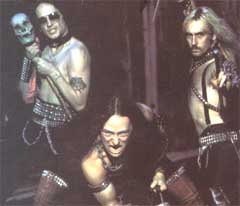 Artistically, black metal sought to exceed the narrow direction of reaction to mainstream events that the increasing trend toward morality in death metal brought. Resentment over "jogging suit death metal," which reduced lyrical focus to politically acceptable social sentiments, boiled through black metal. Its original concept revolved around "evil" and occult mysticism, from which it got the name "black" (as in "black magic"), but this rapidly gave way to its Romantic and Naturalistic side, which soon united several concepts around a general idea: the natural world is more important than a society which has no values except money and not offending anyone, and meaning is discovered when one accepts death (a form of occultism in itself) and is willing to look outside the boundaries of the self. Vast, metaphorical songs with epic titles ("I am the black wizards" and "My journey to the stars" come to mind) resembled small classical pieces more than popular music, with multiple themes converging over the course of poetic movements, and the values espoused in aesthetic and interview hearkened back to Pagan Europe and in some cases, to the Vedantic religion of Indo-Europeans before that.
Ignored were moral concerns over the survival and political rights of the whole of humanity, supplanted by a concern for the natural environment and pre-Christian tradition, as well as an appeal to the "eternal" - that which existed outside of a "progressive" society and its politicized march toward individualistic utopia. While these musicians were strongly independent, they distrusted illusions such as total autonomy of the individual, immortality and universal absolutes such as "freedom" and "justice." Theirs was the world of the wolf, the blizzard, and the indefinable idealism of those who exist alone in nature. Ideology and causes of intellectual desire drowned out the hedonism and lack of discipline of previous eras. Black metal was responsible to nothing but itself, and the fantasy combined with reality to ferment a neo-terrorist movement.
 Much has been said about the burning of churches and killing of people that occurred in Norway and Sweden, but one thing is clear: where previous metal bands performed stunts to draw attention to themselves, the church burnings and killings were originally not intended for public consumption; they were private acts intended as ideological statements, not promotions for the personalities or bands behind them. That indictment and capture eventually occurred is more a product of the youth and inexperience of teenagers regarding crime than a "me, me, look at me!" approach to publicity. Whatever the intention, as soon as news stories broke that over 70 churches had been burned, and at least five people killed, public attention took to black metal as it never had before. What kept the stories from being something other than human interest novelties was the music: unlike any form of metal or popular music previous, it was epic and spoke grandly of emotional values of a nature not limited to the 15 minutes of fame accorded modern acts.
As black metal grew, from roughly 1991 to 1996, its impetus toward majestic music forced its lyricists and inspirational minds to devise new concepts for creation, spawning a range of sub-styles which each polarized around an ideology: self over all, destroy all, or the variance of ideas within pagan or naturalistic/fascist directions. These each took a different approach to aesthetics, coloring the raw sensation of whole perception of their work in the textures and constructions of different needs. Over time the fire of black metal spent itself, as most of these can only state their apocalypticism once. Astute historians might note that the insistence of black metal bands upon paradox in music and idea produced a massively different aesthetic for the time but spent it instantly once others cloned it with nonsense content in stylistic imitation, as hardcore had fallen.
Where initially many including the creators of black metal viewed its artistic content as being polemic for occult war against Christianity, over time divergences appeared within the same general areas of mysticism, philosophy or politics. As is traditional, Romantic music in any culture tends toward a worship of nature and appreciation for the whole of the past, including Pagan tradition; because of its adulation for natural diversity, it also tends to be nationalistic, or believing that countries should not be "nation-states" composed of political boundaries but should be "nations" composed of unified ethnicities and cultures, as that is how one maintains the different points of view that constitute diversity. However, when one explores dangerous and forbidden ideas, with it come the symbols and concepts which are demonized by a multicultural, liberal democratic society.
 NSBM, or National Socialist Black Metal, became a phenomenon after Norway unloaded a surprise dawn attack and swept the genre, but the extremist tradition in thought had been present for far longer than that. Where Iggy Pop's guitarists may have worn Nazi emblems out of pure provocation, or Slayer displayed emblems of both Satan and Hitler for an antisocial reaction, the new bands stated what many in the community had been thinking for years and further, invited it into their thought process to influence their music through am embrace of pan-European and Greco-Roman classicist ideals. They affirmed their need to exist as national populations, and condemned the invasion of Judeo-Christian belief and non-native peoples into Europe, as well as praised forbidden figures such as Adolf Hitler, Ted Kaczynski and Pentti Linkola. Fascism and eco-fascism were endorsed as an alternative to the weakness of individualism, which in the eyes of these bands had with Christian thought led to a separation of modern humanity from nature, tradition and honor.
The romantic streak of metal recurred with many destructive acts, and then amazingly fast black metal sold out in 1995 and death metal returned as longstanding artists improved technicality and specialized artistically. To say "sold out" in this context means to reveal the fundamental principles of an effort to be motivated by short term human desires, most commonly monetary greed or public image. Making extreme music is a fine line between art and "entertainment," where in the latter media pander to the anticipations, weaknesses, lowest common drives and energies of the general population. As black metal's indulgences went from obscure opera to dinnertime comedy circus (Dimmu Borgir, Cradle of Filth, Dark Funeral), the faith of the public in the genre began to wane, and a new range of fans began to replace the old.
As it collapsed black metal reverted to a surefire crowd-pleaser: 1970s style heavy metal and simpler forms of fixed harmony music. As the older bands who were "true" to what had once powered their works, after years of band and social interaction as a result of their art, became repetitive or commercialized, the playing field was equal for any entertainer. This egalitarian style of black metal pandered to the crowd and became the most popular genre of any "underground" metal, ever. The results of the first wave of "entertainment black metal" became mixed with underground styles, and the genre was inundated by simians imitating media icons and classics toward which a morality of "true"ness exists. By 1997, the consumer could buy black metal in the flavor of his or her caprice: underground, melodic, punkish, electronic. Content no longer mattered. Novelty in style dominated with the exception of a few dedicated souls.
 Q: on ""blood, fire, death" an epic sound is present through the use of longer songs with greater symbolic significance to their movements and motifs. what inspired this change from the dark, heavy and primitively simple music of "under the sign of the black mark"?
 Probably from reading biographies on masters like Wagner and Beethoven and their works. I began to listen to classical music shortly after forming Bathory, and from 1985-1986 it was all I would listen to. I had been playing various types of rock in various constellations since 1975, so picking up Wagner, Beethoven, Haydn and others really broadened my musical awareness extensively. The motif signature naturally comes from the world of opera.
Quorthon, from an interview
Period 7 [ 1996 - PRESENT ]
As the Clinton era of American leadership wound down, a new confidence emerged in the world. Unprecedented wealth brought on by the Internet boom, and a world political strategy which encouraged the bombardment of those who did not tow the capitalist liberal democratic line, enabled America and her allies in NATO and the UN to take on newfound importance. Europe unified itself into a financial consortium known as the European Union, and as a consequence international business took on new power and importance. It seemed that modern society was finally reaching its apex, and nothing would stop its might.
History - [ Globalism ]
Small conflicts were both inconclusive and victories for the liberal West as it smashed dictators in Yugoslavia and the Middle East; back in the USA, the Clinton administration generated a flood of legislation empowering minorities, women, homosexuals and other marginalized individuals (except metalheads). The internet, arguably the most important development during this time, became popularized with AOL in 1996 and by 1999, it seemed everyone was getting online. Worldwide countries were linked up and citizens could share information and make personal connections. Consequently, a boom in liberal thought occurred once again, as it seemed that truly understanding and moral righteousness were triumphing over the darkness. With a President who played in a jazz band, smoked pot and considered himself "the first Black President," America felt it had lived up to its covenant with liberal democracy. In fact, this was the era in which the Baby Boomers, or children of the 1960s and 1970s, experienced the greatest degree of political power and those who were pre-war children retired.
Other advancements included the distribution of cable networks into more homes than ever before, and the marketing appeal of American media gaining worldwide audiences. It seemed as if nothing could stop the progress of progress. The Unabomber was convicted, multiple civil rights trials convicted people from the draconian past of racial discrimination, and Hispanic immigration into America blossomed as did racial mixing, promoting a newfound sensitivity that people in the 1960s only dreamed. With the maturation and power seizure of the "hippie" Baby Boomers, the Counterculture had triumphed and the New Left had gained power in the most respected and oldest ways. Further, the Y2K bug, which had threatened to crash the world's computers and plunge us into a primordial chaos, had no effect and was beaten by an army of well-paid programmers. It seemed nothing could stop the advancement.
 As the new millennium dawned, a new presidential race brought doubts, characterized by Atlantic magazine as the conflict between "Red" (rural Americans, conservatives, traditionalists) and "Blue" (cosmopolitan Americans, liberals). The outcome of Gore vs Bush was both uncertain and definite, as so few people turned out to vote that an election could be decided by a handful of votes in a single state. The old divisions re-opened when George W. Bush took office to inherit the "dot-com bust," in which over-valued Internet stocks collapsed, and a recession that eroded confidence in American prosperity. That was followed almost immediately by terrorist attacks on the World Trade Center and other locations in Europe and the Mideast, showing that a new adversary - representing a conflict between older, nationalistic Islamic republics and the progressive American regime - would heat up the future. Western citizens immediately felt the old divisions of the Counterculture vs Culture return, except that this time, neither necessarily was "in charge" but both existed in a pluralistic, multicultural democracy.
Metal - [ Retro-cumulative ]
During this time, the movements of black and death metal, having spent their initial impetus, relapsed into a process of searching past influences for a "true" strain of each genre. The result was a reactionary "retro" movement which inspired brief revivals but then flagged. Death metal returned in force, with older bands releasing new albums and newer bands putting out releases that at the time seemed promising, but since none of it was sufficiently distinct from the past (or each other), there was no direction to be had. This is not to espouse some "innovation," as music has been so well-defined that there is no room to innovate, but there is room to create, and apparently, the creativity of these acts lagged behind where their shows of allegiance to past proven styles did not.
 In black metal, the controversy over NSBM died down once the white power/white nationalist movement absorbed it, creating bands whose topics were solely about the propaganda they espoused, unlike the original NSBM bands who stamped out songs about topics related to their ideals as they would exist in life itself; the new bands, like white power punk and metal before them, essentially ranted out propaganda without end. Unfortunately, for the bands that weren't NSBM, a worse fate awaited: repetition of past symbols and "unique" novelty reconstructions of the same, causing them to rapidly fall into a droning litany of praise for black metal itself, and internal dialogue of black metal itself, without finding in it what had made it great and inspired. The result was a flagging of the genre.
The populist front of metal in the meantime had two fingers, the first being a hip-hop/emo/metal hybrid known as "nu-metal," and the second being a reactionary movement which praised 1970s heavy metal hybridized with speed metal technique into a new form known as "power metal." This was at least an honest if simplistic gesture, and brought about a resurrection of the metal spirit in those who had been young in the 1980s and late 1970s, enabling them a bit of nostalgia as their dollars flowed into supporting the genre.
 Once these changes were visible, the supporting commonality of belief behind black metal fell away completely, and its actions became wholly responses to developments with the metal and punk genres. It is probably fair to call this new genre of black metal "black hardcore," since in music and ideology it has more in common with the punk rock and punk hardcore of the middle 1980s than it does to black metal. Predominantly liberal in direction, it espouses either Satan or "equal" death to all human beings, and bands are virtually indistinguishable between each other in part because, unlike the original black metal bands, they rely on three-note riffs and radio-rock style song structures.
In response, almost all of the old black metal bands either quit, became "heavy metal" versions of themselves (Immortal, Enslaved, Gorgoroth), or took an honorable exit into electronic music, as Burzum, Neptune Towers (Darkthrone), Beherit and Ildjarn did.
At this point, black metal is reliving the past that hardcore experienced. A few seminal acts created something great; others, mistaking the form for the substance, emulated it and expected to be as profound, but weren't, so instead they campaigned for lowered standards. The result is an egalitarian free-for-all where almost no musical effort is being made, most energy going into socialization and image, and the result is that black metal has become that against which it railed. People die, genres die. Only the deeds of honorable artists are immortal.
Art - [ Universalism ]
 With immigration to America and Europe at a record high, and enfranchisement of non-conventionally-favored groups occurring, most art at this point in time emphasizes the universal nature of human experience and equality of all people in an attempt to profit from the purchasing habits of these new groups (one might point to movies such as "Save the Last Dance" and "A Day Without a Mexican"). Music, literature, and art are howling out the theme of the importance of every point of view, especially those where the position of the individual determines what its values should be, and the result is a cacophony of voices that have divided the art market according to the background and political preferences of the buyer. As such, it is hard to derive any trend from these but universalism: a moral belief in the equality of all people, the importance of the individual and its choices, and a desire to crush any "oppression" or marginalization wherever it is found.
Influence - [ Hip-Hop, Techno ]
Similar to the condition of metal are the genres of hip-hop and techno and alternative rock, which are also out of ideas and fragmenting to pander to different audiences. While originally maintaing a strong pro-black-community outlook, hip-hop has now become home to rappers with a range of different skills and outlooks, including those which reduce it to a marketing gimmick designed to sell "extremity" to suburban kids. The positive outlook, PLUR (peace, love, unity, respect) community which techno became in the late 1990s has lost focus as raves have begun catering to an older crowd who seem more serious about drug use than music. Alternative rock? Like other rock genres, it has been absorbed into the generic pop realm and now resembles indie rock more than it did previously. Genres like country and pop punk have suffered the same norming.
 The influence of metal on these, and their influence on metal, is for the first time not direct: it wholly affects outlook and lifestyle philosophy. Where once only pop bands chanted a mantra of "be distinct, be unique," it is now the province of black hardcore bands to differentiate themselves with affectations and recombinations of "profound" ideas borrowed from mainstream sources. As it was something to do in the 1970s or 1980s to have an indie or punk rock band, now it's an activity for lonely teenagers to record black hardcore albums on their computers and to trade them with "friends," guaranteeing each other a tiny slice of the cheap immortality afforded by recognition without respect. Ultimately, this serves to strengthen the original convictions of death and black metal more than reduce them, in that where mainstream and metal once crossed paths, it has again been proven that they are incompatible.
Conclusion
The metal movement migrated from a position among the Counterculture as a rebel to one of denying everything the Counterculture stood for, prefer to eschew the intermediate tradition and hail what occurred thousands of years before the modern world. The domain of rugged individuals, it went from hedonism to rejecting the individual-over-all preference so that it might find meaning in the process of life itself. And finally, it grew from a position of denying all value to inventing value where society has publically declared that none exists. What brought about this extraordinary journey?
 Since its genesis, metal music has been "outsider art," looking inside society from the basic position of "I don't like what I see." In a time of absolutes and universals, it looked for the ultimate answer, the truth that laid waste to all else, in part to reconcile its members to their position outside of society but in part in a desperate search for something to hold on to, and in which to find meaning. Over the course of several generations it distilled this value system and found its connections to knowledge outside of the realm of popular music.
Oddly enough, it has done this by embracing the lack of meaning in a nihilistic deconstruction that presupposed significance existed elsewhere, since that which had public meaning made no sense to someone who could recognize the importance of the morbid end awaiting each of us. Its outsidership, unlike the political and lifestyle alternativs others chose, was based in feeling and not tangible elements or ideas within society. This brought it full cycle from a rebellious adolescence to a warlike but life-affirming adulthood.
In this transition there is hope, as for every adolescent who takes one look at the adult world and says, "Take it back - it's broken!" there is this path of learning. While for now metal music has lost its impetus and been assimilated, this path isn't unique to metal, and in many ways, metal can be considered one vector of re-introducing this truth to a forgetful (15 minutes, Orwellian memory hole) modern industrial society based on the convenience and wealth of individuals. One can hope for the future in following this transition, and as an epitaph to metal, organize the ideas with which any future generations would start:
- Nihilism - from Vedic and European transcendental idealism, the idea that nothing has any significance or value inherently, only by the valuation of a human mind.
- Ethnonationalism - from Latin America to the Nordics to the American Indians to Malaysians to Chinese to Zulus to Hispanics worldwide, metallions recognize natural ethnicities as the only vehicle for their unique national culture.
- Environmentalism - a great horror of humanity is the destruction of earth and anti-corporatism and environmentalism are part of this.
- Melodic poesy - the sense of melody and layering of the same as central to any complexity in composition, developed further toward a language in which uniqueness is appreciated over novelty of form.
- Anti-moralism - a fear and resentment of morality as a construct at all, preferring nihilistic and deontological moralities.
- Heroism - personal pride and passion for honor in existence will be seen as more important than social approbation.
Any future movement that hopes to transcend the ills of this era must heed well to what metal has discovered: one cannot use external force (carrot and stick) to force things to fit into a framework or worldview; the force must come from within. Without a culture emerging to support a consensus of values, one is left with yammering monkeys using authority to beat on each other for the gratification of their own sense of self-importance. This is "absolutism," and it is represented in things ranging from money to morality to the war on drugs to the crusade against "racists" and "terrorists." Metal discovered by exploring experience that this absolutist, universal, mechanistic viewpoint was illusion, and that what was real was the life that all along we as modern humans have hidden past layers of interpretation and religious dogma derived from dualism.
 Schopenhauer wrote the philosophy of the "will," urging awake a force to life in each person that aims toward a refinement of the human being and a focusing of ambition toward life and desire for existence. Nietzsche's "Will to Power" is a technical restatement of this to clarify that while the will is indeed all, presupposing a lack of external world that may resist your will is ignorant. Nietzsche rightfully brushes aside the trivial question of "Is reality real?" by suggesting that a system of consistent reactions and structure will always be "real" in that it has effected us, and our interaction with it affects our survival which in turn is important to the system. He rails against contentment and moral dogma, and suggests the evolution of humans to übermensch status - people fully accepting the nihilism of life and moving forward to embrace what design, evolution and passion have to offer.
This cuts aside much of the guilt and ineffective action of the world voting public. Someone told to save the planet will join an organization for saving baby seals that mails stamps around the world to collect donations, but will not be able to tell you a single action except "drastic change" that would actually solve the problem. A postmoral person will correctly respond that most sufferings are tied to a few central problems, and that the largest is general disregard for the environment. The übermensch that Nietzsche wrote of could arise, but by the suffocating nature of a media-fed democracy will be an extremist; after that, the next generation is to be a lone wolf for forms of radical change through thought.